
FIP: The Lottery No One Wants to Win
An old disease, a proven treatment, and the underground networks supplying hope

I’m coming to you bone tired and filled with hope this week.
I had been working on something completely different. I was writing about belief — what we actually believe when no one is watching, when no one is shaping the answer for us. I had an outline, a direction, and it was a piece I felt good about. It felt nourishing.
And then everything shifted and my writing-plan was replaced by my household winning the slim-odds lottery, once again.
This week, Christopher and I took our first Saturday off since before we were married. We attended the wedding of our friends Jeramie and Katy and later picked up some equipment from Lowe’s on the way back to the barn.
We’d recently, despite all feelings otherwise, moved a television into the bedroom. Neither one of us is a bed watcher, but when Dad was sick, being able to hide in the bedroom and engage in some mindless escapism was vital. When Dad passed, we never moved the TV back to its rightful place in the living room.
I say all this because if that television hadn’t been there, and we hadn’t decided to eat super late, and if we hadn’t decided to watch TV while eating, we would have missed the most subtle signal that our little, teeny, tiny baby Indigo was extraordinarily sick.
Indigo was perfectly fine most of the evening. She’s a quiet cat, absolutely unbothered by anything, so it’s hard to see changes in energy level and demeanor. Throughout the evening, I unpacked the moving boxes and arranged closets. Indigo hung out on the kitchen floor, watching me come and go.
As we settled into the bed to eat, Indigo took her spot in the little nest of blankets I make each night for her beside me. A couple of times, she rose and mewed at the closed bedroom door. That was odd. Then we watched over the course of the next hour, her move to her litter box, produce very little, and jump out, over and over, at least fifteen times.
I assumed she must have a UTI. There was much discussion. Christopher offered to take her to an emergency vet. I hesitated, then walked up the stairs to get a second opinion from my mother.
Mom’s answer was simple, “I will drive her myself,” she said — and Wanda hates driving after dark. This was followed by,” If something happened to baby Indigo, you will have to dig two holes.”
Christopher loaded Indigo up and embarked to the closest 24-hour ER. I stayed home because I had an early morning of lessons. If you’re noticing a parallel to the tragedy of Sheba, I promise you don’t have to send an anonymous letter to the farm to remind me that I allowed someone else to do my work. The whole point of a marriage, or a structure of community, is to divide the work and find balance. We’re here to help each other and bolster our strong points.
A few hours later, I was mostly sleep-dazed when he returned at 4 AM without little, teeny, tiny, baby Indigo.
Christopher was on it. He gave me all the information. He explained that the vet suspected kitty Covid — also called FIP — and that the vet on call urged us to join Facebook groups to source medicine.
It sounded ridiculous — the vet encouraging us to find black market drugs?
Christopher explained that we could source pills or injections, but the vet preferred the pills.
I read Indigo’s intake notes. The clinic had to first rule out lymphoma and other diseases that mimicked FIP. Indigo was anemic and could be in need of a transfusion. I would learn later that there are three types of FIP: wet, dry, and neurological. A few weeks before, Indigo had a swollen eye. We took her to our primary vet, but her eye was fine and had resolved by the time we arrived.
She’s a laid-back kitty, so we never noticed a drop in energy. She is a picky eater, but we hadn’t been monitoring her food intake. She wasn’t losing weight — or at least that’s what it looked like with her puffy, round belly.
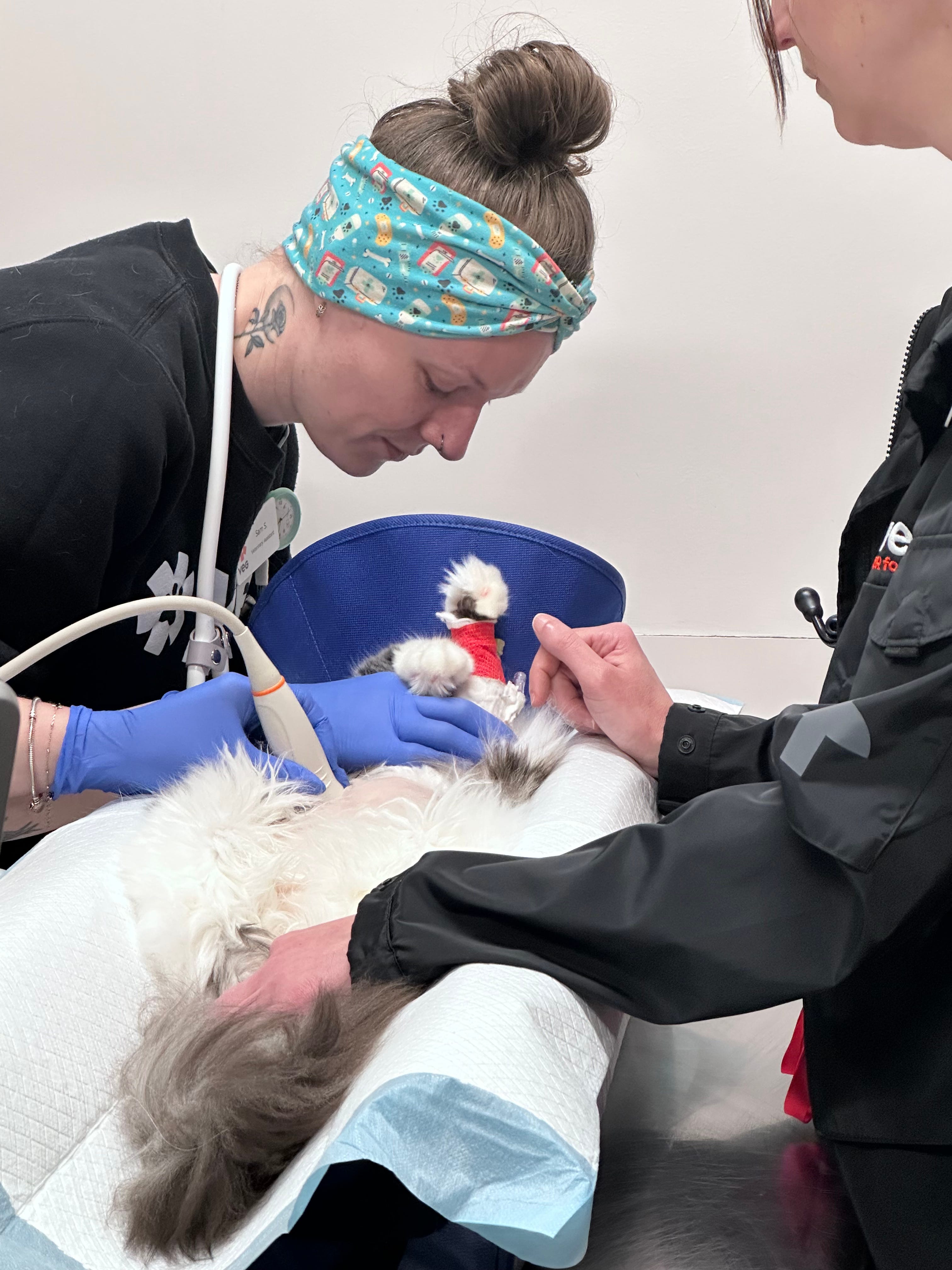
The ultrasound performed when Indigo arrived at the clinic showed the hallmark of FIP — a round, bloated belly. Protein fluids had built up around her abdomen and lungs.
I didn’t know at the time that we had hours to source medication. I assumed the vets would have options and keep us informed. Figuring Indigo was at least being monitored overnight, I went back to bed for a couple of hours.
When I woke Sunday morning, I snapped some photos of Indigo’s intake paperwork and sent it to her breeder, Susan, in Nashville.
“I don’t know how to say this lightly,” she wrote back, “but the bloodwork does indicate FIP (feline infectious peritonitis). It is treatable with medication that your vet should be able to prescribe.”
I immediately called the emergency clinic and checked in with the vet, who informed me they could not prescribe the FIP meds and did not keep them on hand. Just like the night before, the vet urged me to join Facebook groups and find someone with a local stash so we could source our first dose. The vet told me that she could not be present in the room with us while we administered the dose, but that we were free to come and give it to Indigo at any time.
The vet could not be present in the room.
Untreated, FIP is one hundred percent fatal.
Susan rushed to her car with her personal stash of GS-441524, the only drug that can fight the horrible viral, immune response, and began the seven-hour trip to upstate SC. This wasn’t her first time helping a cat in need. Meanwhile, I began contacting groups on Facebook, these worldwide, grassroots organizations dedicated to getting treatment in the hands of FIP-positive cats in their communities.
I had no idea how much I would have to learn in so short a period of time.
My whole life revolves around animals. I thought I was well educated on most of the things that can go wrong with creatures and how to fix the problems — or not. But as Susan rushed to her car and I began chatting with people from all over the world, I began a 48-hour crash course in FIP, a mysterious immune response to common feline coronavirus.
FIP is extraordinarily rare. We’d hit the jackpot.
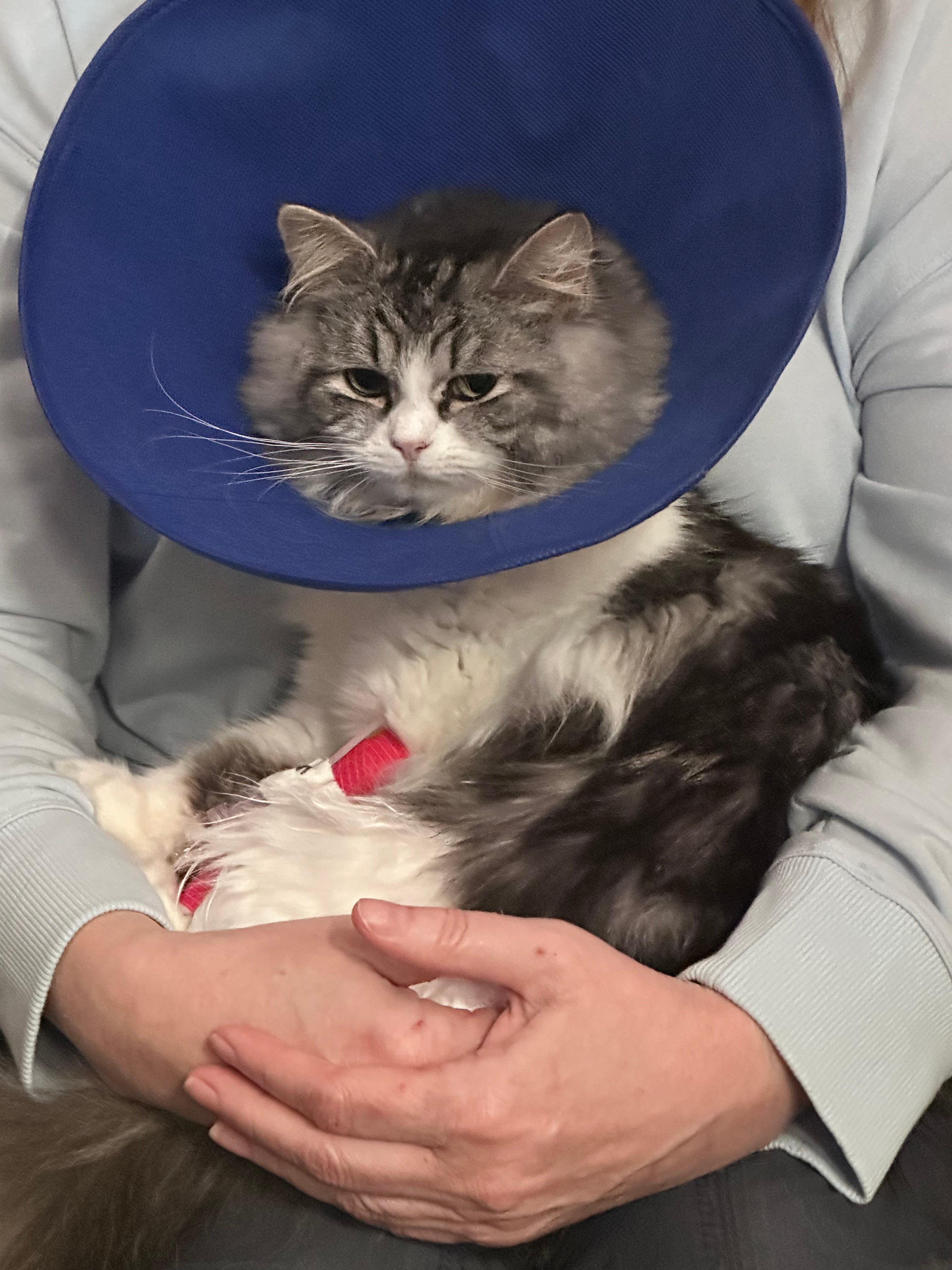
Most cats are carriers of feline Covid, and most will show few signs when the virus is active. Many cats are lifelong carriers of the virus and experience no problems. But a select few, mostly under 2 years of age, will experience an enormous rogue immune response to the feline coronavirus, in which their bodies turn against themselves, and their immune system attacks their healthy systems.
That has been the sentence, unchanged, for most of the last sixty years.
FIP arrives months or years after the initial virus runs its course. There might be a genetic component. It might be caused by big stressors — like a move. No one really knows.
Feline infectious peritonitis was first described in the early 1960s, a disease that veterinarians learned to recognize with unsettling clarity long before they could do anything meaningful to stop it.
By the end of that decade and into the 1970s, researchers had identified coronavirus-like particles in affected cats, and over time the picture sharpened into something both specific and deeply unsettling: this was a coronavirus, but not one that behaved in the clean, predictable way.
FIP is rare, but the virus itself is very common.
Feline coronavirus is everywhere, especially where cats live close to each other. Many are exposed, and many carry it; however, most will never become seriously ill. Coronavirus exists in the background of the cat world — ordinary, unremarkable, and largely invisible.
In a very few cats, most under 2 years old, the virus begins to mutate.
In those cats, what had been a relatively contained, enteric virus gains the ability to live inside the very immune cells meant to destroy it. It moves into macrophages and begins to travel through the body, attacking as it goes. Blood vessels become inflamed, proteins leak, and fluid accumulates. Organs begin to fail under the onslaught of an immune response that has lost the ability to regulate itself.
Their bodies, in trying to fight the virus, become part of the problem.
For most of its known history, FIP lived in that narrow, unbearable space where medicine could explain everything except how to stop it. From its first formal description in 1963 through the following decades, veterinarians grew increasingly precise in recognizing the disease, understanding its mechanisms, and predicting its course.
By the 1970s, it had been linked to a coronavirus.
By the 1990s, an internal mutation theory began to explain why some cats developed the fatal form while others did not. But none of that changed the ending. For more than fifty years, the timeline between diagnosis and loss was not a question of if, but when.
The first real shift didn’t come until 2017. That’s when a compound called GC376 — a protease inhibitor — was shown to meaningfully alter the course of the disease in naturally occurring cases. It wasn’t a complete solution. Neurological cases remained difficult, and not every cat responded, but it was the first time anyone could point to something and say, “This changes outcomes.” It broke the long-standing assumption that FIP was simply beyond reach. It didn’t solve the problem, but it proved that the problem could be approached.
Then, almost immediately after, more answers were uncovered. Between 2018 and 2019, research on GS-441524, led in large part by Dr. Niels Pedersen at UC Davis, showed something far more definitive. Cats with naturally occurring FIP were not just stabilizing, they were recovering. Their fevers dropped quickly, their appetite returned, and their systems began to correct themselves.
By the time the 2019 field trial results were fully understood, the conversation around FIP had fundamentally changed. It was no longer accurate to describe it as automatically fatal. There was a treatment, and it showed a shockingly high promise of recovery.
Because GS-441524 was not some unknown compound drifting in the margins of science. It was developed under the umbrella of Gilead Sciences — the same company that would later bring remdesivir into global use during COVID. The data existed. The outcomes were real. The need was undeniable.
Long before most of the world was thinking about coronaviruses, researchers studying FIP were asking the same questions we would later ask in hospital rooms during COVID. Can you stop this kind of virus once it takes hold? Can you change the outcome if you intervene at the right point in the cycle? Can something that feels inevitable be interrupted?
The compound that began to answer those questions in cats, GS-441524, isn’t a distant cousin to remdesivir. It is what remdesivir becomes once it’s inside a body. It’s the active form of it — the part that does the work.
Long before most of the world was paying attention to coronaviruses, researchers working with FIP were already asking, and beginning to answer, the question of whether these viruses could be stopped once they took hold inside the body. When COVID emerged, that knowledge did not have to start from zero. It was already there.
And yet, despite all of this, the compound that made a cure for FIP possible was not developed into a widely available, FDA-approved veterinary drug in the United States.
Researchers, like Dr. Pedersen, began connecting cat owners with drugs manufactured overseas, mostly from China, where the product could be produced in the absence of US approval. Online communities formed to share information, guide each other through treatment, and coordinate access to the medication. People who had never met each other became the bridge between knowledge and survival.
A slim chance was better than certain death.
These online communities taught each other how to dose, inject, and read bloodwork. They came together, staying up through the night in desperation knowing that someone on the other end of the screen was doing the same.
These underground networks filled the void that veterinarians were not allowed to enter.
In May 2024, the U.S. Food and Drug Administration announced that it does not intend to enforce certain regulatory requirements against veterinarians who prescribe compounded GS-441524 for cats with FIP, provided specific conditions are met.
The FDA also stated that there is no approved drug for FIP in cats in the United States. But, the new policy allowed veterinarians to prescribe GS-441524 compounded from bulk substance for individual patients, while the drug itself — known to work — remains unapproved.
In essence, veterinarians are now legally free to discuss where the drug can be obtained without fear of enforcement by the FDA.
And that is why, in the middle of the night, a veterinarian urged us to find answers to a fatal problem — a medical problem with a known answer — on Facebook.
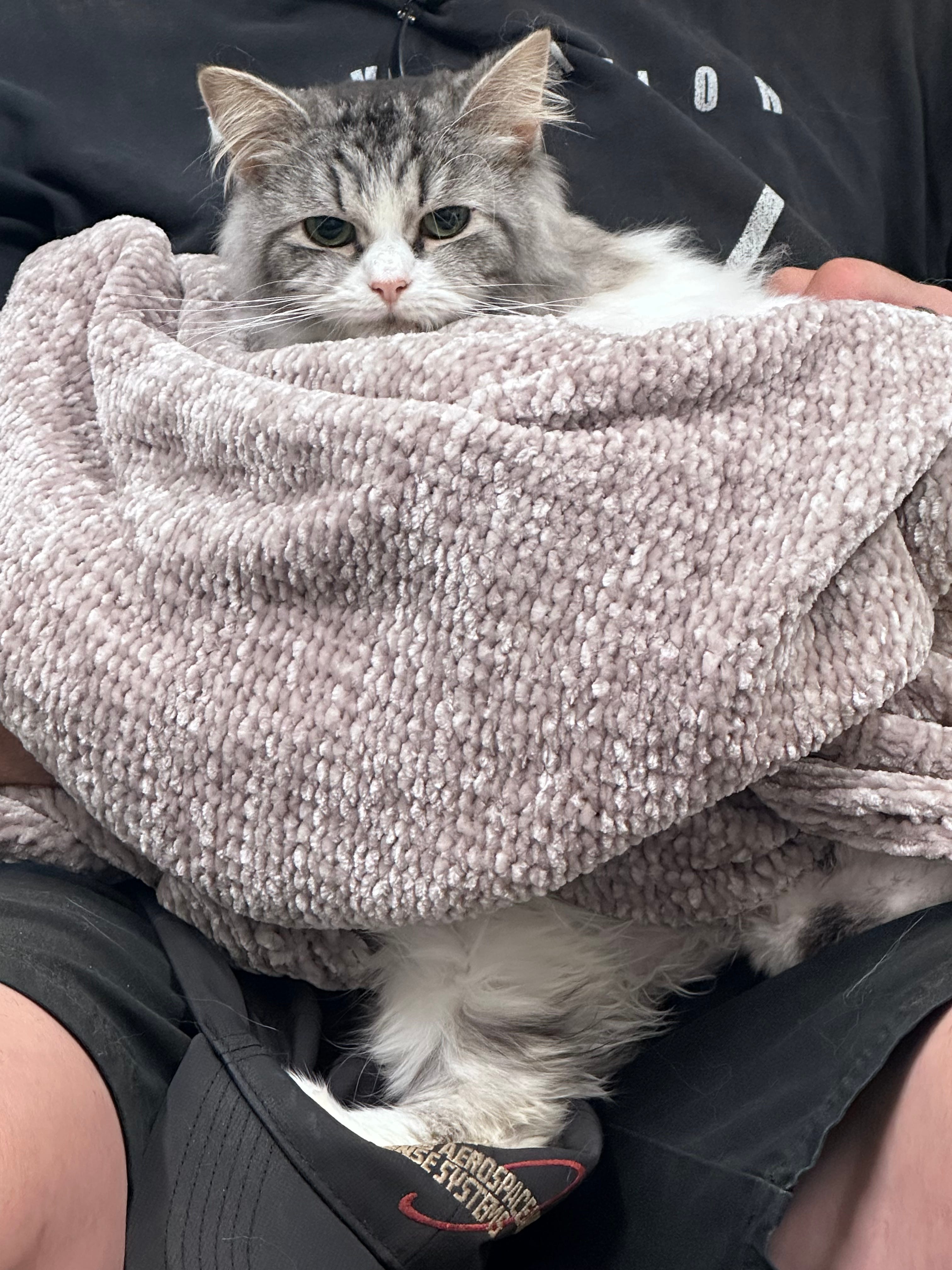
We broke Indigo out of the big house on Monday evening. She has good odds. We caught FIP remarkably early, and the earlier a cat is diagnosed, the more they respond to the treatment.
Cats are sacred in many cultures.
I know it feels like the world has gone to hell, and there are so many other things that need our time and attention. But as I wrote in my post the other week, cats are my antidote to despair. And this little blue Siberian in particular, little baby Indigo, is a delight that has soothed so many of my traumas in the short time she has been with us.
Indigo will continue treatment for the next 84 weeks. She is on day four of the GS-441524 protocol.
Cats are treated once daily for a minimum of 84 days. The dose is based on the form of the disease and the cat’s weight, with wet (effusive) FIP, like Indigo’s, typically starting around 4–6 mg/kg. The goal isn’t just to make her feel better, but to fully suppress the viral replication long enough for her body to reset and regain control. Early on, we are seeing small but meaningful shifts. Her energy is lifting, and her appetite is slowly returning. Her treatment continues well beyond those first signs of improvement in order to prevent relapse.
Doses must be administered consistently. They can’t be skipped, and must begin at the same time every day. We’ve downloaded a spreadsheet to help us keep track. Alongside daily treatment, a team of veterinarians will monitor her bloodwork over time, watching as albumin rises, globulin falls, and overall stability returns.
Some cats begin with injections for reliability and later transition to oral medication once they’re stable. The team of angels I’ve been in contact with tells me the injection is slowly fading out, and Susan also felt more comfortable starting Indigo on tablets. The first doses were sourced from a lab in China. After a lot of pressure, the emergency vets wrote a very small prescription for me to source a two-week supply from a US compounding pharmacy. The script has no refills.
So I reached out to the people at Harmony and Rose, who connected me with a larger community online. Almost immediately, I was in contact with someone in Athens, Georgia — a person who has helped treat over 3,000 cats with FIP.
I started sobbing as soon as I heard her voice on the phone. She had answers. She was a living laboratory of proof, information, and hope.
When I asked her about the legal risks to the community organizers who help people source a full course of treatment, she said she would welcome anyone who wanted to question her work. Because without this drug, the cats die, while we are living in a world with the knowledge that makes FIP treatable.
But we are also not in a world where the path to treatment is easy to find. We are in a place where decades of understanding, breakthrough science, and lived experience have changed what is possible — while the structures meant to deliver that possibility are still catching up, unevenly, imperfectly, and far too slowly for something that moves as fast as this disease does.
This is the history where Indigo has found herself. And it echoes the tragedy of humans seeking medical help in the US. All of this is a microcosm of the greater, weirdly regulated system. It makes no sense.
Treating FIP is not a small expense. The medication alone, over the 84-day protocol, typically runs between $2,000 and $5,000, and in many cases climbs to $8,000 or more, once weight, dosing, and complications are factored in. That’s before you add diagnostics, repeat bloodwork, emergency care, and the support needed along the way.
If I didn’t have insurance on my two Siberians — at Susan’s instance — treatment would not have been possible.
For people without insurance, the cost makes treatment impossible. That’s where the community networks that help people access treatment also step in to help fund it — groups like Harmony, FIP Global, and FIP Warriors (and others) coordinating donations, reduced-cost medication, and support where they can.
In forty-eight hours, we learned how to source a drug that isn’t waiting for people on a pharmacy shelf. We learned how to understand the protocols. We learned the language of weight, absorption, and timing, and why we can never miss a dose.
And the crazy part is how few veterinarians want to touch this problem. They deeply care, but their hands are tied with legal uncertainty. There is a treatment that works, but the risk is too great for them. I felt the ghost of this as we spoke — the way they stopped short, worded carefully, and the way their clinical notes passed the burden on to us — the owners want . . .
So whatever this looks like from the outside, whatever words people want to use for it, whatever discomfort it creates — I know where I stand in it.
I will not fail to use the information we are gaining through this experience.
If there is a way to make this easier for the next person — if there is a way to be a point of contact, a place where someone doesn’t have to start from zero at two in the morning, trying to understand a diagnosis that just changed the shape of their life — I will be that.
I will become part of that underground network that already exists.
As I work to get Indigo through this, I will be stocking the medication and doing everything that I can to help someone else’s cat. Because we wouldn’t be on day 4 of Indigo’s treatment with her brightness returning, watching her play with a piece of packing paper, without these underground networks.
The lessons I am learning through Indigo — as with all the creatures who have come into my life — will be far reaching with hope.
Help me spread the word.
Love,
Kim
It's insane! You're right. It absolutely is a "microcosm of the greater, weirdly regulated system." These systems are, by their design, not meant to help. I thank my lucky stars for this network of brave and smart folk who don't give a rats ass about holding up bureaucracies. I love you!
Speechless! How can a situation like this even exist? If it exists for cats, it will surely be happening for humans, and other creatures! Back to the dark ages….