
That Time I Bought a Cat
And then purchased another

“These cats are a delight,” my mother said, holding the stoic, fluffy lump of mostly grown and always unbothered Indigo. “What did we do before they arrived?”
I really can’t remember what we did before the two Siberian kittens joined our house. This past year has seen so many changes, and I feel like a gooey caterpillar right now, waiting for spring to take flight. The world outside the farm feels like chaos, and I’m counting down the days to Easter by noticing things that might have escaped my attention if I weren’t peering closely — the henbit that grows green and low throughout the fields, the way the sunset stays bright long enough for me to finish throwing hay and locking up.
The way Gideon, the older of the two housecats, positions himself before dawn on the bathroom counter and stares out through two large windows to greet the day. His silhouette, from where I lay on the bed, looks like a painting.
“You’re such a good protector,” I tell him.
I have given a home to numerous barn cats in my meandering career with horses. Barn cats are charming and necessary tools in a farm’s battle with rodents. As I prepared to move into the old farm and as we rushed to get settled in the new spot at Lavender Hill, I swept dusty corners clean of rat poison and mouse traps. All of this is easily solved with a barn cat or twelve, and without poisoning the environment.
We have barn cat retirees dotting the yard, garage, and porches — one is actually named Dotty. The seniors tend to work for a decade and then cash in their 401-Ks (meaning, daily buffets from my mother), leaving the hard mousing to the young-ins.
Only twice have I bought cats — each in 2025, the year of transition for so many of us. I never once, in my entire life, thought about spending money for a cat. I spend money ON cats all the time — but paying for the acquisition was a brand new concept to me.
This is how it happened.
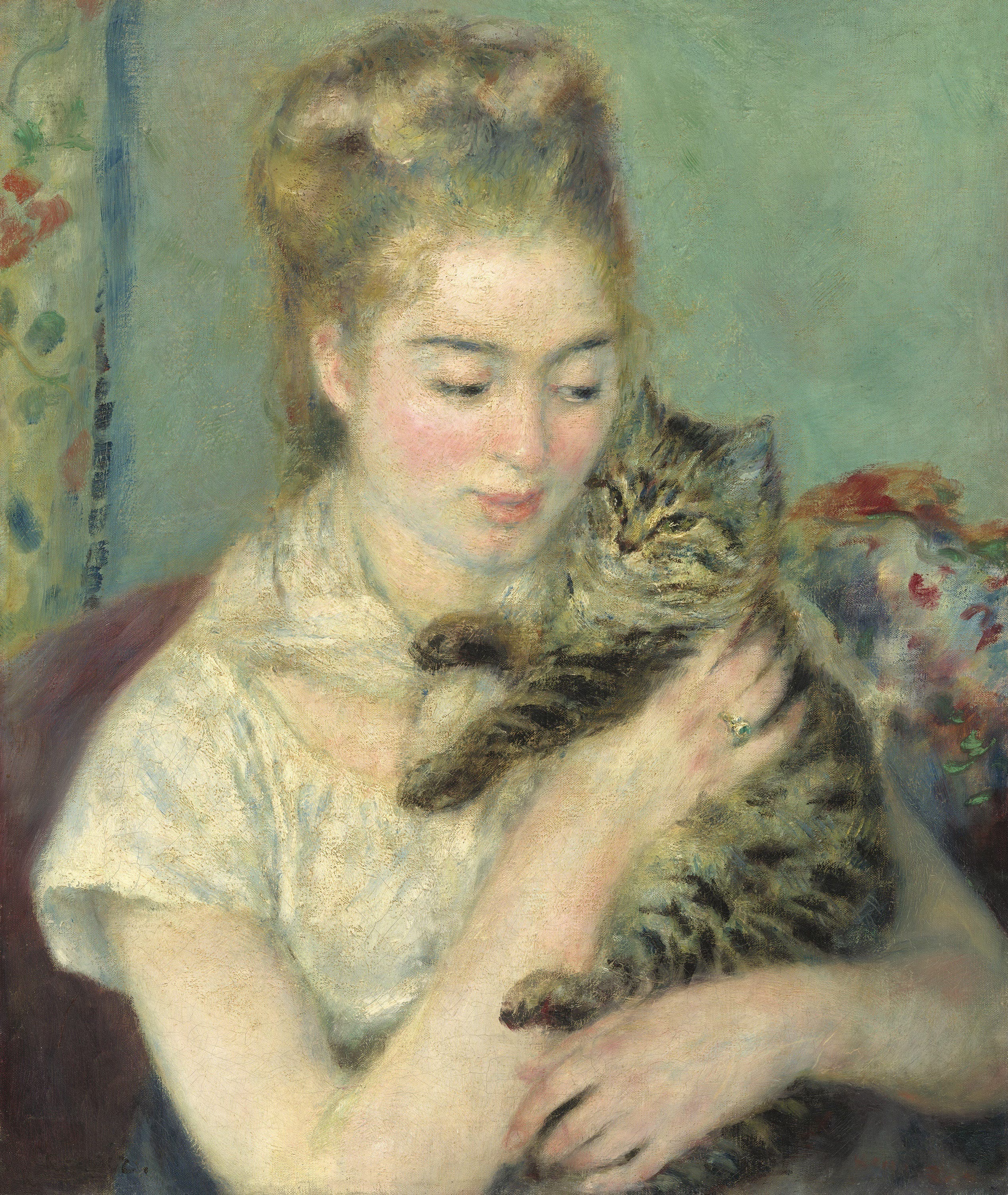
My cat journey started in Russia. Not too long after the fall of the Berlin Wall, I accompanied my grandfather on a grand Russian tour from St. Petersburg to Moscow. He was there to spread capitalism. I was there to look at art.
Our first stop was the Hermitage Museum. Lost French and Post-Impressionist paintings were confiscated from Germany at the end of WWII and remained out of public view for 50 years. The hoard included lost masterworks by Renoir, Monet, Degas, and Van Gogh. I studied art in college, and I salivated over the chance to see these works in person, by random chance, when my grandfather booked tickets to Russia in 1995.
On our first full day in the country, we toured the Hermitage Museum at breakneck speed. By the time our group reached the room housing the lost masters, I had ten minutes to view them all, buy the book, and rush to the bus.
What I didn’t know at the time was that Impressionistic art would eventually bore me, and that cats would take their place in my life. The Hermitage is important for that, hear me out.
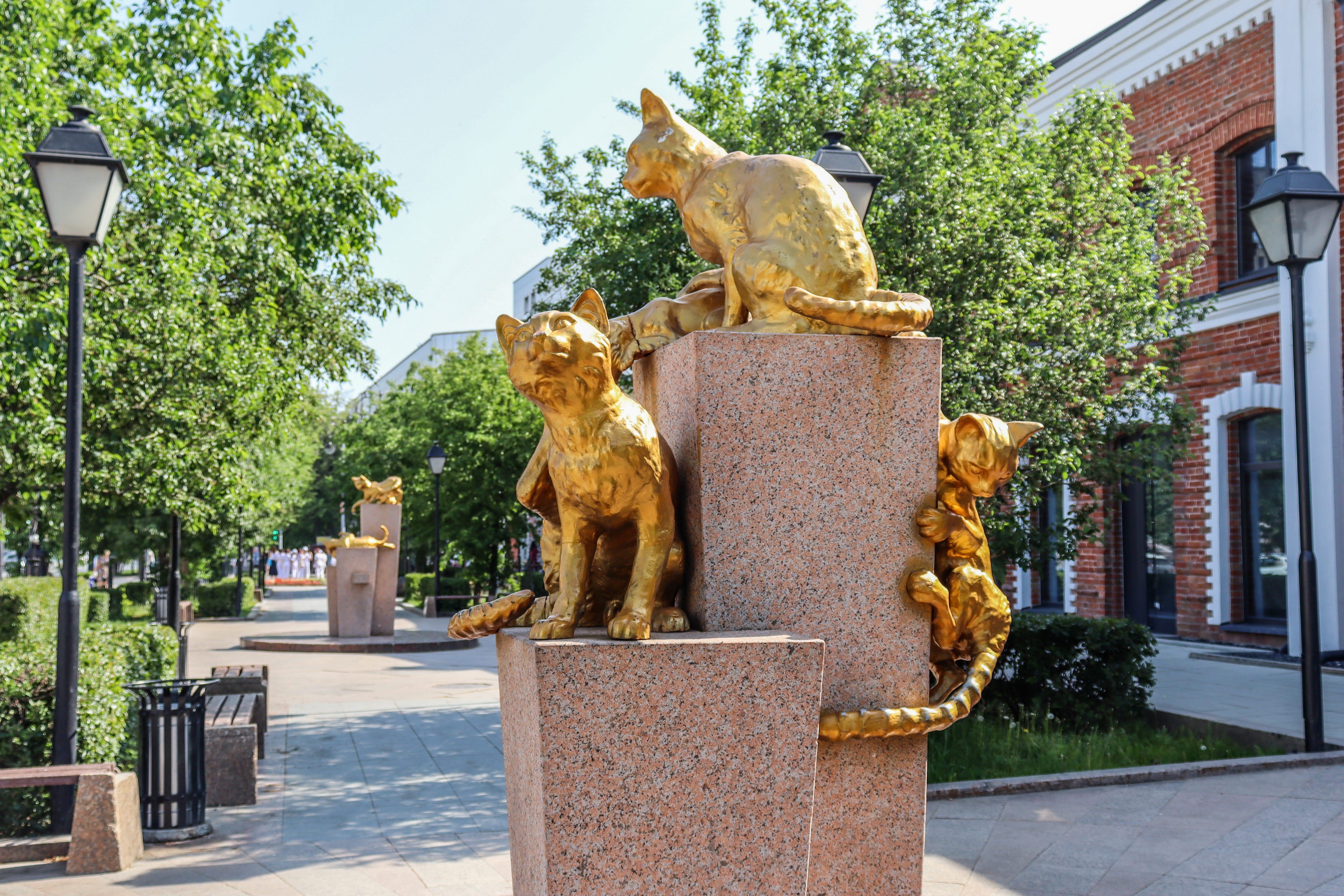
In 1745, Empress Elizabeth Petrovna issued an edict ordering the thirty best cats from Kazan to protect the Winter Palace from rodents. Later, Catherine the Great would dub these kitties, “guardians of the picture galleries.” The cats remained through the Napoleonic invasion, the Bolshevik Revolution, the Soviet era, and are revered inhabitants of the Hermitage Museum to this day.
Even with the addition of chemicals and traps to solve the mouse problem, the cats always achieved better results.
During WWII, some art was hidden in the Urals during the three-year siege of Leningrad, but what remained was being destroyed by rats. The people were starving, and most of the city’s cats had become dinner.
To solve the problem, more than 5000 cats were brought by train from Siberia.
When I arrived home from Russia in 1995, my roommate greeted me with tiny, brindled kittens. I shared a rambling, historic house with two guys. We each dominated our own floor. John lived upstairs. While I was away, he had some French girls over, and a lot of drinking ensued. When one of the girls opened a window in the rooftop bathroom because she felt ill, a pregnant, delicate Abyssinian cat crawled through the window.
John named her Abby, and he kept the mamma cat the rest of her life. I took one of the kittens and named him Ivan after a kid I’d met on a cruise of the Volga River. Ivan, the kid, would pop his collar when he saw me coming and practice American pick-up lines while I judged his accent and tone. He taught me Russian phrases. I coached him in English. That kid’s face is forever inscribed in my mind, and his legacy lived on in the name of my half Abyssinian/half street cat, who went on to be my constant partner for 20-plus years.
Ivan the Cat (sometimes Ivan the Terrible and also Ivan the Very Very Bad) knew me better than I knew myself. He was always waiting for me to catch up. He slept on my pillow and allowed me to play with his feet. And once, when the former roommate John was visiting, he taunted Ivan, who was stretched on top of the refrigerator — Ivan waited until John’s head was turned and then very purposefully slammed the freezer door in his face.
Ivan taught me that animals communicate with us telepathically. It’s easier to get that memo from a cat than it is from a horse — I don’t know why. Why do you all think that is? Maybe because cats dumb it down for us, and horses expect us to do our own work?
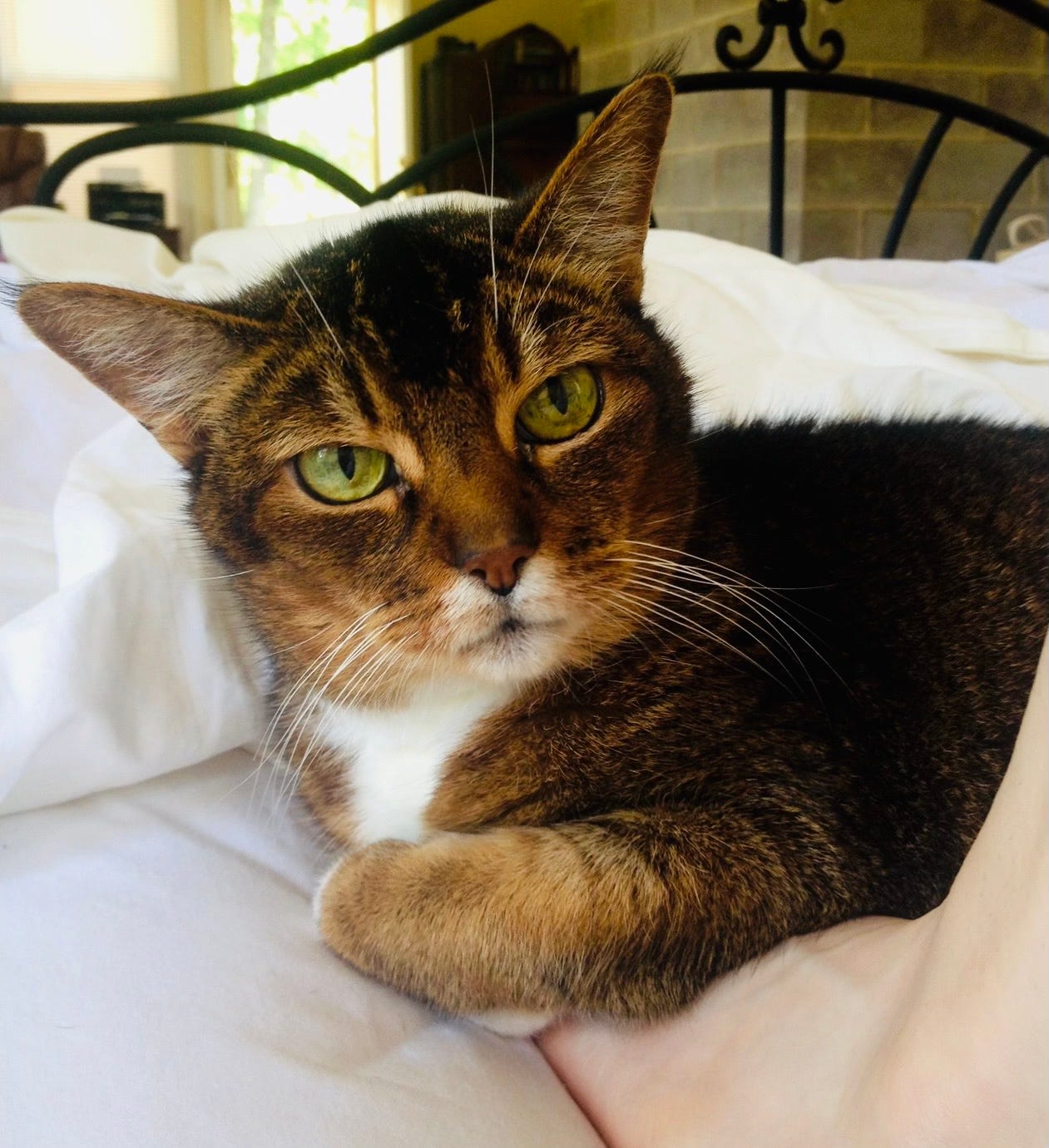
When Ivan passed, he was old for a cat, but it felt like an integral part of my spirit had been carved away. I swore that I would never acquire a new house cat — the litter boxes and the hair on the surface of everything.
I stuck to that for a very long time.
And then Christopher and I married, and Hurricane Helene changed my mountain landscape, and it became absolutely necessary for me to find a Maine Coon. Like a siren call or a tornado siren, the urge was immediate and precise. But I’m allergic to cats (and horses, and dogs, and grass, and trees) and I’d enjoyed a reprieve of swollen eyes and stuffy nostrils in the time since Ivan had passed.
“You should consider a Siberian,” Harriet, an encyclopedia of cat knowledge, said. “They’re hypoallergenic.” She connected me with Susan of Keuka Ridge Siberians in Nashville.
I’d never purchased a cat before. The idea made me morally uncomfortable but strangely hopeful. Ivan’s hallmark Abyssinian characteristics made him the ultimate companion for two decades, but he was a foundling — as are most of our animals at the farm. Horses come to us when they’re ready. I’d purchased many horses for the program over the years, but the ones that found us without my striving have historically been the best fit.
My work revolves around rehab, both horses and humans, and every decision I make is guided by trauma-informed principles. What happened to you, before you arrived here, that guides the decisions you’re making today?
I needed a clean slate, an animal that would allow me to not be on the clock. I wanted to let go of my urge to help, fix, or save — I wanted to just relish the companionship. It didn’t hurt that Siberians are also incredibly fluffy.
Susan sent a photo of a shy, runt-of-the-litter named Gideon.
A few weeks later, we picked him up.
And because Gideon would be lonely by himself (like the horse-distribution service, you can’t have just one), we traveled to Nashville a few months later and picked up baby Indigo.
The day after Indigo arrived, my father moved into the farmhouse on hospice. Like the cat purchase, his coming to live with us was an impulsive decision, rooted in our hearts. His hospital bed took up the guest room, and the rhythm of my life shifted overnight from familiar horse chores to medication charts, adult briefs, and listening for changes in breath. It was like monitoring a horse in nonstop colic. I never had time to truly rest.
And then, as if life was conspiring to test the tensile strength of my nervous system, we learned we were losing the farm we had stewarded for two decades.
It is strange to admit this, but the cats were the last indulgent purchase before everything in my life was pared down to necessity.
After Indigo, all spending stopped. We tightened the budget until it felt like a tourniquet. I counted hay bales and payroll cycles. We measured fuel in miles and time in invoices. Stuck in small acts of survival, we did the most rational/irrational thing of all — we purchased a historic farm and moved to Lavender Hill.
In our ongoing transition, all extra spending stopped because there was no extra left.
When I look back at the timing, I can see that buying Gideon and Indigo was not frivolous. It was preemptive medicine and an investment against the emotional toil that was barreling toward us. I didn’t know my father would die at the new farm. I didn’t know that sixteen horses would begin the journey here, but only fifteen would make it through the gates. I didn’t know how thin my nerves would be stretched trying to hold everything together at once.
But something in me knew I would need witnesses who didn’t need anything from me but a soft place to sleep and some occasional pets. I needed creatures who noticed the sun rising and setting, reminding me back into an older clock.
I have spent my life acquiring animals who required rehabilitation, integration, and management. Their histories become my responsibility. The Siberians were different. They arrived with lineage papers and soft coats and no trauma story for me to untangle. They were not projects for me to fix — they were pure presence for me to sink into and breathe.
In the months that followed, when the bank accounts dipped, and the spreadsheets grew teeth, and grief and fear braided themselves into my daily decision-making, the cats remained indifferent to the drama. They leapt onto the counter during budget meetings. They sprawled across the closing documents. They purred against my ribs while I lay awake calculating risk at two in the morning.
If the farm was the bold, public investment in our future, the cats were the quiet, private ones. They pay invisible dividends, even when Gideon breaks into a loaf of bread and acts shocked when I find him nibbling on it.
I bought two cats on the cusp of my life collapsing — and then I stopped buying anything at all and bet everything I had on the land. I bought the farm with a pen and the cats with my pulse — one was a wager on the future, the other was insurance for my soul.
And when everything else was stripped down to risk and responsibility, it was the kittens’ indifferent purring that reminded me I had not gambled my life away. I had anchored it, finally. And, as with any good transaction, the cats were there to witness and make their mark.


After a lifetime of considering myself a dog person, I think I’m actually a cat person. The realization is like developing a new neural pathway, and I’m pretty sure that was the cats’ intention, a form of neuro-linguistic purrrr-gramming.
I even pulled Tamar Reno down the Siberian mousing hole. She is now the proud human to two Siberians, Gideon’s mother and full sister. Tamar likens them to Russian operatives, or raccoons. They’re busy. They’re into everything, all the time.
Gideon is our busy cat. Indigo is an old soul, a creeping, sloth-like watcher.
All this has shown me that I do not just like cats; I require them. I need the low hum of another creature in the room who is not asking anything of me, who is not waiting to be fed information or scheduled. The cats exist on their own time, and occasionally, I’m honored to be invited in.
Last week, lessons were postponed due to steady, misting rain. Fog hung low over the farm, and the house fell into a rare and almost sacred quiet. There were no trucks in the driveway or voices at the gate. Inside the house, where I sat writing, there was just the soft thud of paws jumping onto the desk, and the flick of a tail across my wrist. The cats curled beside the keyboard and breathed me into their realm of noticing. It was as if the air itself thickened around me and made a container for thought.
The cats move through the rooms like old house spirits, weaving between sentences, and reminding me that writing is a practice of sitting still. In that waiting, things begin to surface.
It’s impossible to be still on a farm, which is funny because I built this life to have time to write. But my life circles around tending the horses, the people, and the land. In the endless logistics of keeping these systems in motion, I need the cats, my quiet familiars who offer a gateway to deep presence.
I bought a cat, and still had some space left in my endless motion, so I bought another. My goal wasn’t collecting animals, but I needed to build a room inside of my life where I could think, where I could listen, where I could remember who I am when no one is watching — except for them.
Cats are always watching, and if I am wise, I will let them teach me how to do the same.
Love,
Kim


"I have spent my life acquiring animals who required rehabilitation, integration, and management. Their histories become my responsibility.”
I cannot un-feel these words. I have spent years collecting and tending to both humans and animals that needed help untangling their true selves from their trauma. For some, when the wounded show up, there is an immediate need to begin caring, tending, and healing.
Three weeks ago I said goodbye to our “failed foster” boxer dog who came to us mere weeks before the pandemic collapsed the world around us. Sealing the deal that this broken, anxiety ridden, outwardly disaster of a dog was ours to love and heal. He gave me 5 years of continual lessons in what trauma does to our bodies long after the threat is gone. He also gave me 5 years of continual companionship and connection, quite literally, as he was my constant shadow. A 65 pound lap dog with zero understanding of personal space.
Now, our girl boxer is a solo dog. Your writings about your cats remind me very much of her. She is the most cat like dog. Simply existing in the space, providing the soft low drone of snoring while she sleeps curled at the end of the bed. She occasionally decides to share space and will rest her head on my feet, but that is the extent of her comfort with closeness (which is a little bit of her own trauma story still living out 9 years after coming to the safety of our home). Overall, she is very low demand and I am finding this, as you stated, to be a pure presence for me to sink into and breathe. I hadn’t seen it that way. I couldn’t see it that way through the loss of the larger, more vocal presence.
Thank you for sharing your stories of the trauma informed work that you do, and also sharing the ways you find to recover from such weighted work. Thank you for reminding us to slow down and keep looking, noticing, and drinking in the beauty that is there even when darkness threatens to overshadow it all.
I was uplifted by your purchase of Gideon and those lovely purr reels. To answer you question, the difference between cat and horse is the eyes. Cat's eyes can bore into you and connect and they are also facing you. The horse eye is more elusive. You know both better than me, but that's how I feel when I am around both. My friend Ivey has a horse with blue eyes and he and really connected because I had to visit him everytime I came. I didn't fell his thoughts but he felt me and the last time I went, he wasn't in his usual greeting place in the fenced in field. I said something to Ivey as I walked to the house. He's getting old and you know...I'm not there often. But the minute I walked out there was, standing in front of a stall. Just to say hello. I think horses receive us faster than we can receive their answer.