
But Will There Be Riding?
An essay about horses, algorithms, and protecting silence

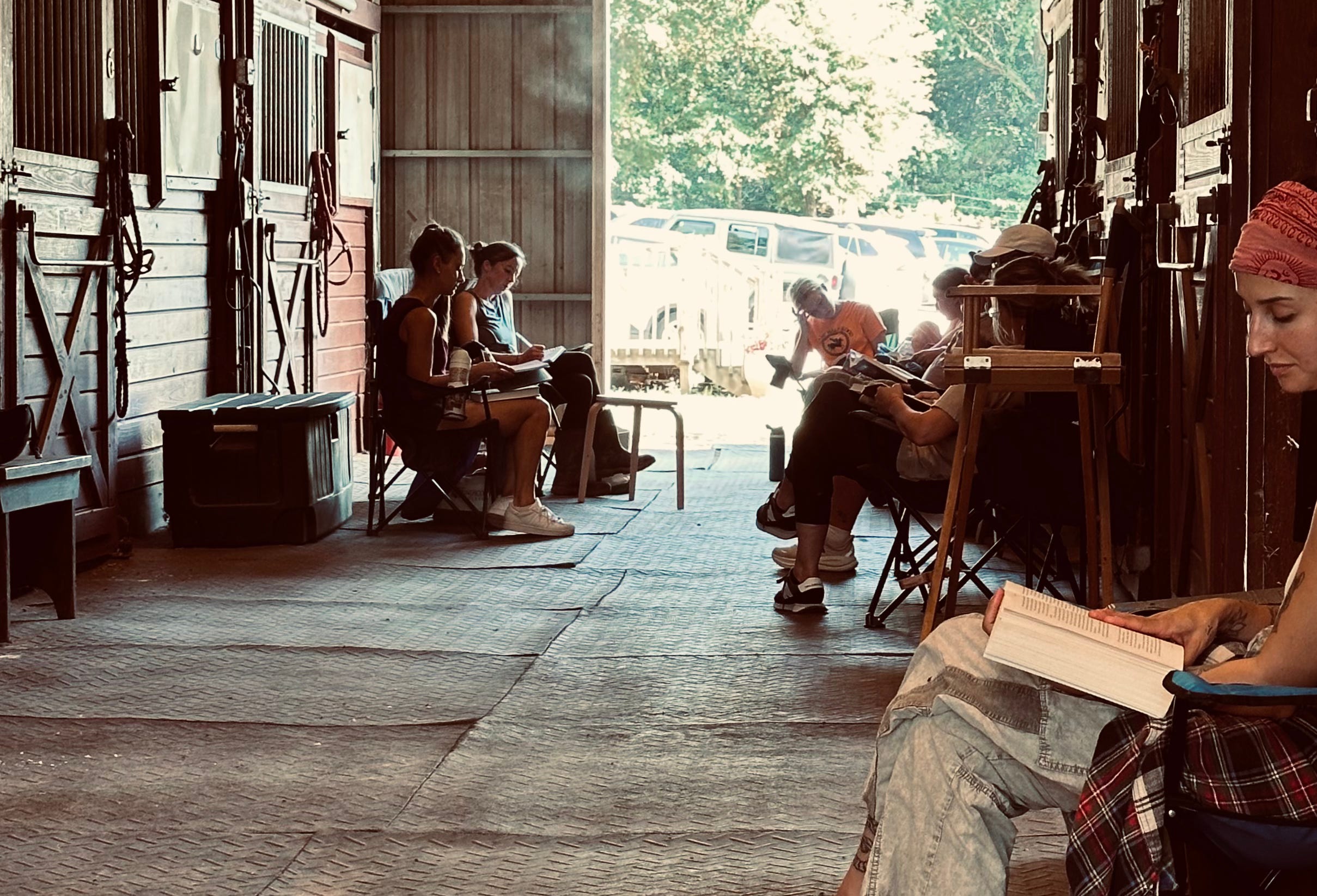
I’m sitting in the hallway of the barn with a bunch of people I’ve just met. We’re reading silently to ourselves and writing in our notebooks. I am rarely given an opportunity to just be. Time like this has to be carved out deliberately, like the watermelon Stephanie brought, its yellow fruit shocking with its cool sweetness.
After the initial awkwardness, there are few things so comforting as sharing silence with a group of travelers searching for the same things. I think about religious communities taking vows of silence, why they do that, and what they find when the newness of their loud selves has faded, and they are left with shared space and body language — like a horse.
This isn’t the first month that we’ve held Books at the Barn — a fully democratic book club held on the last Friday of every month, a club where no one tells you what to read. But it’s the first time we’re welcoming newcomers beyond our regular farm family.
I made a little post on Facebook announcing the date. It wasn’t the first time I’d advertised the event on social media. I used a recycled image and quickly threw together an informal description.
I posted and went on with my evening.
Later, I sat on the mower while my earbuds chimed with notifications, but I assumed it was all virtual junk mail, and hardly glanced at my phone. So it was several hours before I saw the numbers of comments and views on the post announcing Books at the Barn — 7,000, 14,000, 28,000.
By the time the traffic began to trickle later in the night, we had 40,000 views.
I quickly pieced together a welcome message for people curious about the event. I made a spreadsheet because I will make a spreadsheet for every second of the day if I am given permission to organize the seconds, for you, for me, for your mother.
Books at the Barn spreading like wildfire made me so thankful, but it also pissed me off.
Please Keep Your Hands Inside the Silence
Ninety percent of my spreadsheet-curated life is spent creating content. I’ve designed websites since their infancy, had a following on LiveJournal, and predicted the demise of the Yellow Pages in the paper phonebook while arguing with the reps at AT&T about their blackmailing, shady, ludicrous ad pricing.
I have lived the rise of the internet. I was an early adopter of social media because all my friends in Turkey had iPhones and Facebook. I will still fight anyone who would like to argue that WordPress isn’t unreasonably complicated.
I have blogged, I have edited without Grammarly, and I’ve made friends with AI — particularly for scenarios when someone contacts me because they want to volunteer at the farm, but can I pay them? And they can only work three hours on a weekend, and they’re pregnant so they can only work for three months, so would I please give them a call to speak to them on the phone instead of texting?
AI keeps me kind and keeps others safe from my darker verbal impulses. It’s like a governor on my sass engine.
When people boast to me about how they don’t take part in social media, I applaud them. Still, I don’t have the luxury of living a fully organic life off the screen, no matter how much of mine is spent covered in a layer of dust and sweat dripping into my eyeballs.
People find the farm because of the content we place online.
Writing is my love language, but keeping up with the ever-changing algorithm can be a chore. The words you’re reading here are exempt from the business of keeping the farm relevant. I write for me, to you, each week. No matter how much it drives me bananas, a blog doesn’t stir new business for the barn very often, but it helps me connect with the world — and that’s why this is my favorite time of the week, sitting here with you and telling you about my world.
I use a lot of words and paragraphs when I write. This trait doesn’t make me a darling of the algorithm.
That’s why I spend so much time asking those of you who have found me here, you people who put up with my wordiness, for your support. I’m so deeply thankful for how you all, many of whom I have never met, keep the farm going. Your presence here keeps ME going.
As for social media, on a good week, I can make a little post about an event at the farm, and it will maybe reach one new person who will connect with us — and then most likely not commit to attend whatever event captured their interest.
But I am thankful for that too.
That said, I never in a million years thought Books at the Barn would draw attention from anyone outside our immediate, in-person circle. Suddenly there were 40k views and more people than I can count on two hands ready to commit. Wow.
We went from having an event I truly enjoy, a time that captures everything I would be doing when given an hour to do anything I wish — namely read and write — to an offering that I had to manage and prepare for.
I found myself with a little jalapeño kettle chip on my shoulder. (If you haven’t eaten these with plain hummus, you’re missing out.)
As stated previously, I spend most of my days creating content. It’s the nature of the beast. One cannot have a business without a social media presence. Writing is who I am. Did an essay go viral? No. Did a podcast episode reach the masses? No.
A post I spent a total of five minutes constructing connected with our local community and beyond in a way that I was not prepared for. How was I going to make certain that these newcomers would be welcomed, immersed, and that we remain true to the spirit of the event?
Boundaries. I’d have to make them, honor them, and not be swayed. Like a hastily erected fence of step-in posts and ElectroBraid rope, this event must stay grounded and connected to a power source.
Luckily, the farm had been working its magic for months prior, preparing me for the task.
But Will There Be Riding?
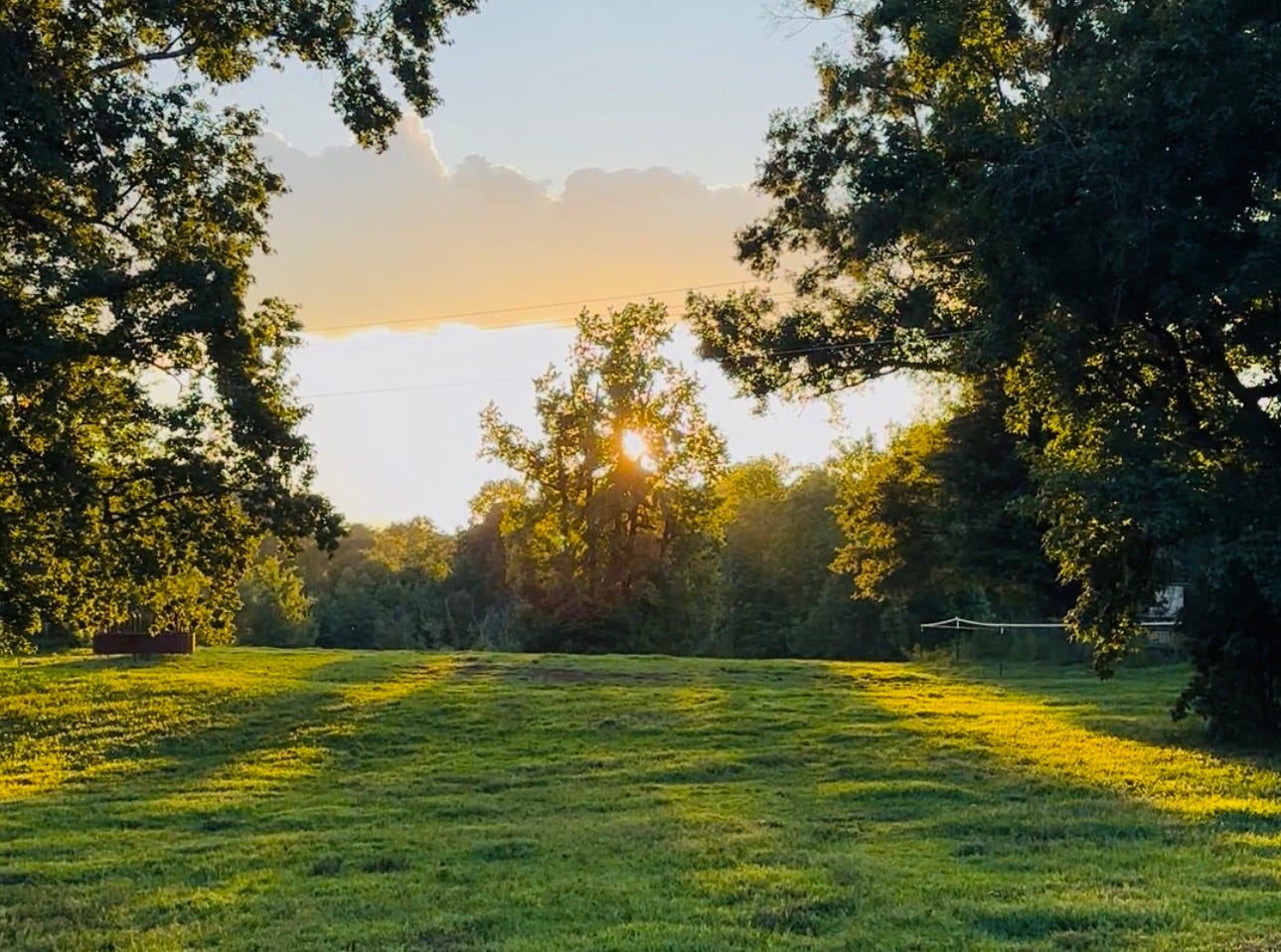
It’s a hard sell trying to prove that silence and stillness hold value — contemplation, meditation, watching a movie, reading a book, sitting in church. We stop and watch the sun set, our eyes fixed and amazed on the horizon. So much of being with horses requires action. The world is determined to get their money’s worth.
Luckily, Books at the Barn is free — so I felt less pressure to produce and keep people happy than I do in a regular session.
But recently I worked with a mom and teenager who stood beneath the misters in the cool shade of the barn. The horses dozed in the cross ties as the pair brushed their coats with unflinching awareness and deliberation.
I offered the humans a choice. We could lead the horses out to the ring and spend some time moving, or we could remain where we were grooming in silence.
At first, the visitors traded responsibility back and forth — you answer, no you answer! I watched them like a tennis match, assuring them that I didn’t have a preference either way.
Finally, a little guiltily, they both admitted that they wanted to remain in the barn with the horses and the brushes, but they were hesitant to let me know they enjoyed it so much. It was their first time at the barn, but even they knew that the world expected them to prove themselves by achieving something notable during a horse experience.
What they’d proven, without trying, was that they could slow down and listen to a horse, which might be the most important task we can learn.
I remember the first time that the teenager who founded Books at the Barn and I were the only attendees. We sat in the cool quiet of the barn hallway, the misters humming with soft fog drifting through the humidity. I wrote quietly in my notebook. The teenager read. At the end of the hour, we stretched and grinned at each other.
I spend hours in the barn every day, but I hadn’t experienced THAT yet, the slow genius of contemplation.
It’s that reverence for the time and the landscape that I wanted to preserve as we opened the event up to the greater public. It’s hard to capture the essence of all that in a welcome email.
As inquiries about Books at the Barn arrived, I didn’t once resort to using AI to manufacture patience for answering the typical questions. I want a certificate or some acknowledgment for this.
Q: Can I pet a horse?
A: Interactions with the horses are not a part of this event, but the horses will be nearby.Q: Can I talk to a horse?
A: You may speak to the horses from a distance, but not during the quiet time set aside for reading.Q: May I feed lettuce to the horses?
A: No, they are not ducks.Q: May I feed carrots and apples to the horses?
A: No, they might choke.Q: Will there be riding?
A: Riding is not the purpose of this event.Q: But will we have a chance to ride?
A: Riding is not the purpose of this event.
I’ve written enough about why our farm emphasizes humans learning groundwork before they ever swing their leg over a horse. People like to toss around the fallacy that I don’t believe in riding. Nothing could be further from the truth. I believe in riding, and people ride horses with me every day of the week except Monday. Monday is for catching up and emails and finding better ways to explain why learning to interact with a horse on the ground is imperative to communicating clearly in the saddle.
But let me reduce our foundational philosophy all the way to the ground:
Beyond horses and riding and kissing a sweet, soft nose (the horses totally put up with this and are daily patient with me when I walk past and boop them, because a horse nose is irresistible) — a horse farm gives humans a chance to slow down and feel their presence inside their bodies. And THAT is how you learn to understand and cultivate a partnership with a horse.
Books at the Barn might sound like it’s a club where we all sit around and enjoy our books, but in essence, it’s an hour where you slow down, quieten the noise in your mind, and tune into the frequency of the herd.
It’s even better than riding, this chance to share space and get to know yourself. It might, and I say this on good authority because I’ve had decades to practice the art of being near a horse, be the most important thing.
But Will There Be Riding?
I’m sitting in the hallway of the barn with a bunch of people I just met. News traveled so fast for an event designed to slow time down.
I try to look from the outside in, remembering the person who needed to quit her real jobs and take a break to be near horses. The horses seemed like the only solution, and I know the core of that girl still resides in me.
I must find her.
We are all searching for the same thing: a chance to calm down while being immersed in the thick air of nearby creatures who couldn’t care less what book we’re reading, or in my case, trying to write. Horses don’t care about human creations. Their concern is lodged in the creation around us: the grass, the trees, the dirt, the sky.
We have to act like we’re doing something to sit next to the whir of the tree bugs as twilight slants the light through the branches. We go on hikes. We ride horses. We mountain bike. We camp. We get desperate when development threatens our dreams, so we throw all our savings on an old horse farm with crooked fencing and trees older than the year the first settlers came and brought their axes to make timber to frame houses beside some spring water in the wild.
I only have to stake my claim on silence once during Books at the Barn. A lovely lady sits beside me at the table in the hallway of the barn. She asks me, in a whisper, to tell her about the horses.
“This isn’t a time for talking,” I say, and immediately feel guilty.
She braces as if she’s done something wrong.
The girl inside of me who is terrified of having her peace taken away if she voices what she wants immediately rushes to rectify, soothe, and deliver the promised goods. “When this is over, we’ll take a walk around the pond, and I’ll answer all your questions,” I say.
It’s hard to return to my notebook for the last fifteen minutes.
The others, some old, some new, pet the cat and turn the pages in books. One watches the horse across from her in a stall. I feel like I need to rise and give everyone a horse experience, but then I question my urge — where does it come from?
From the way that we measure agriculture by production. By the way that we are all trained to only exist by doing. By the acting we should all receive Oscars for as we go about our day.
I choose to remain silent. I plead my Fifth. Not every story can be told with words.
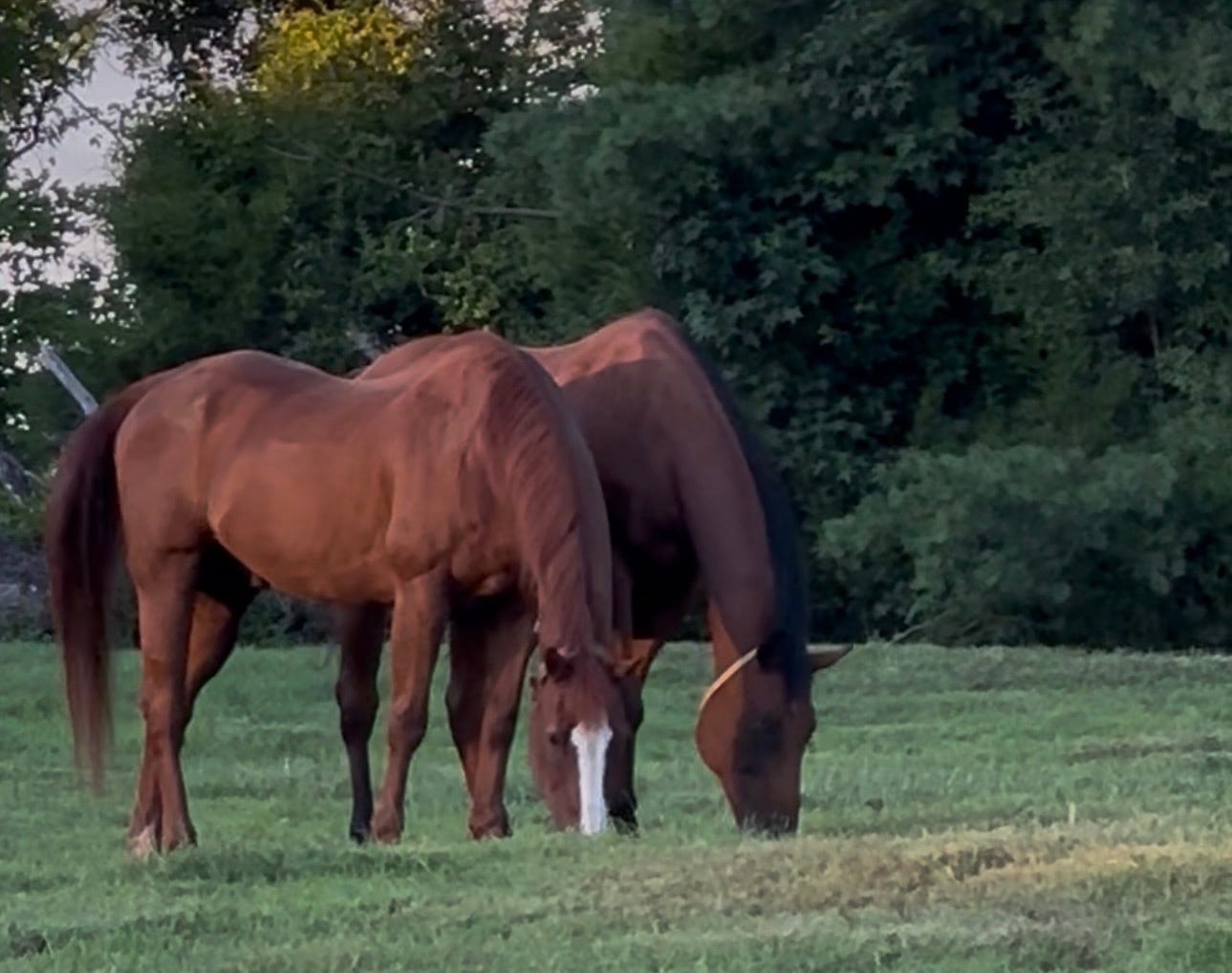
And later, beside the pond, the horses in the graveyard field run over to greet us, curious to know what we’re doing, interested in this herd of humans asking nothing of them except their exceptional presence.
There are times for words, and there are times for silence.
In between, if we’re very lucky, we get to hear ourselves.
Perhaps, for the first time.
Love,
Kim
Oh Kim! I just love this. I am recognizing myself in some of the flaky correspondence; and aim to do better about directness and follow through.
I love reading your words about horses and silence and just being. As my journey with horses continues, I look forward to more time in silence with them ❤️
Grateful the algorithm showed me this post. You're a beautiful writer. So much of this is relatable as we do similar things here in Maryland, but sadly your funny mention of using AI to tactfully respond to "volunteer" inquiries really hit home the most! I reached out when you first mentioned starting books in the barn and told you I was inspired and going to copy. Escaping goats, stuck tractors chaotic summer campers and more have distracted me, but I have been collecting books that I plan on offering to parents interested in bringing their children this fall. Thank you so much for all you share! Hoping your weather is cooler than ours and you're able to enjoy peace filled moments in the barn.