
The Trees Speak
And they don't care about my calender

A few weeks before we were married, Christopher and I walked the woods at our old farm, scouting a spot to say our vows. Tucked between old beech trees in a seldom-visited section of the forest, there was a large pond, its surface thick with lily pads and centered by a drain wheel like a submarine’s, locked shut by years of neglect and corrosion, the water leaking slowly through a rusted pipe at the base of the dam. Some years the pond filled to the brim. Other years it seemed to be receding, draining slowly into the memory of the woods.
The pond was fed by a spring that curved through the cavernous roots of old oaks, exposed like swamp cypress and mythical in shape. If you looked closely, you’d see the outline of an animal in the sculpted roots. Look again, and you’d see the form of a human. The water was temperamental like the moods of the neighbors who slowly encroached on the woods.
Christopher and I had spent many hours at the spring head, terraced in weathered rock. It was a bit of a hike from the farmhouse, but after scouting other locations, we decided that we’d guide our wedding guests down the hills in a single file and stand beside the clear water of the shoals on the day of our wedding.
Knowing that we didn’t own the land that the farm rested on, we figured that anywhere between two trees would be a great place to make promises because wherever we went in the world we’d be able to find two broad trunks to mark the spot.
As we counted down the days to our wedding, we made many trips to that place beside the pond. It seemed like the perfect spot — until the very reason we chose to hold the ceremony there told us, in no uncertain terms, that we needed to reconsider.
A tree spoke.
It wasn’t a very windy day. The tree wasn’t diseased or damaged. It was the same tree we had seen countless times before.
You can find a video of it below. The sound is faint in the recording, but it was so loud and continuous as we stood in the woods that day, listening, trying to capture the noise that sounded like weeping, or music, the pitch changing in volume and tone.
We decided to hold the ceremony in a different spot.
I’m glad we listened to the tree.
A few days after the wedding, Hurricane Helene tore through the forests. Like dominoes falling, the landscape was altered, and soon I was bringing my estranged father home to live with us, and then we lost the farm entirely.
Throughout it all, the trees continued to speak to me.
They’re still speaking to me today.
Drought and flood, hot and cold, the trees, like us, are at the mercy of the elements. We moved into Lavender Hill in September of last year when the trees were still heavy with summer foliage. We’ve had time now to live four seasons together. As humidity drenches the boughs, the trees and I are motionless together in the heavy July air, my roots creeping downward to withstand the next buffeting storm.
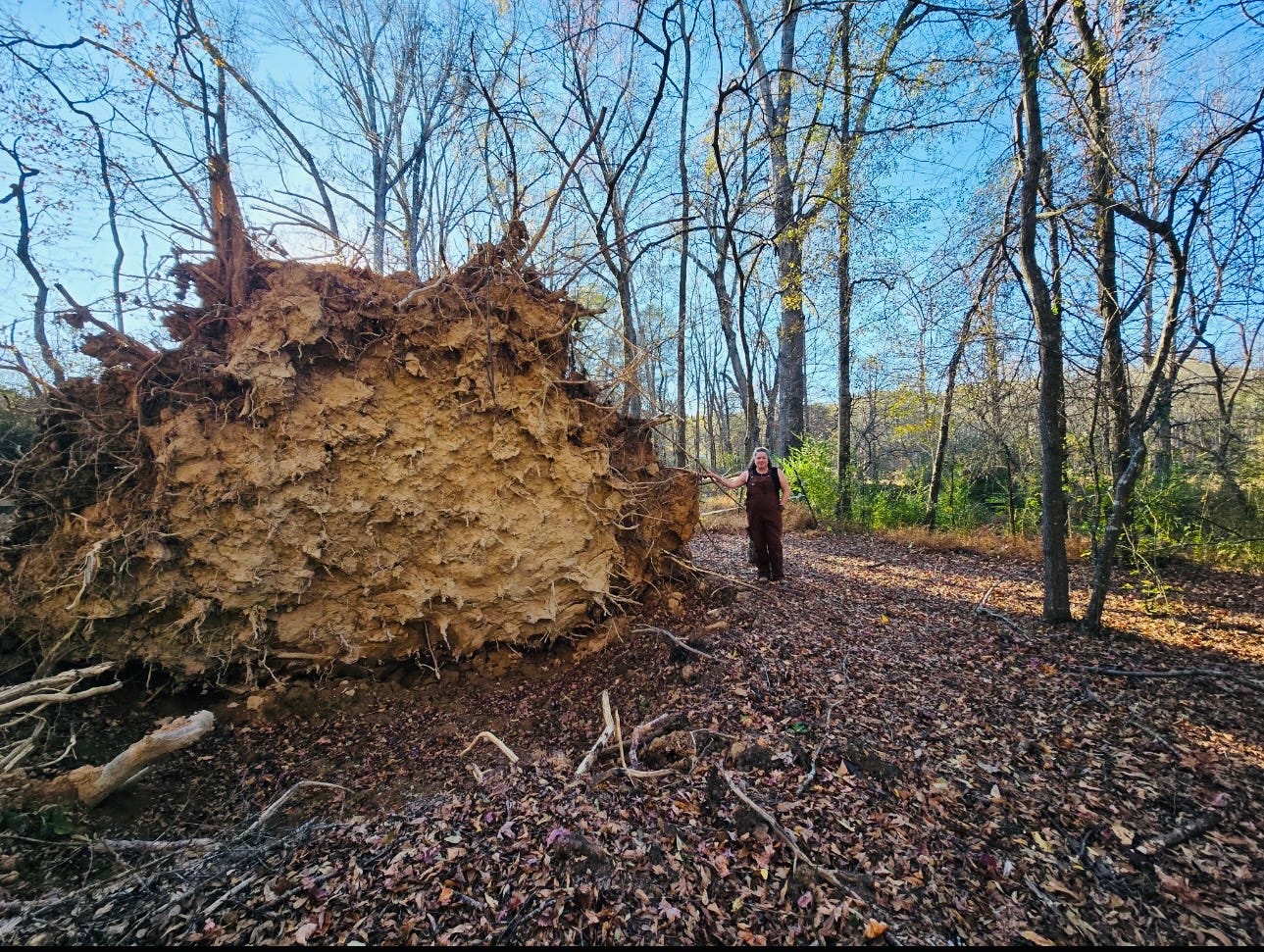
We inherited acres of Hurricane Helene damage when we moved to this land. The farm was vacant when the winds tore through, no livestock in the fields, so the massive trunks of fallen trees were left like monuments along the wood line.
The root ball of one toppled white oak near the creek is unbelievable in size, even when you’re standing beside it. Like uncanny valley in the woods, my human brain can’t comprehend the enormity of this tree facing the wrong direction.
This year, the south was already deep in a drought when we sank into the heat of summer. Every so often, rain fell for days like little monsoons followed by weeks of bone-dry weather.
In every season we’ve lived here so far, storm winds have brought down an expected number of branches, but recently I’ve noticed large boughs from healthy trees dropping in still weather. I walk hurriedly along certain sections of the fence lines as I work because I’ve watched certain old trees drop limbs the size of their brethren.
It isn’t happening on just our land. My great-grandmother’s house is lined by oaks, and they are also ejecting branches, like distressed ships dropping weight. And so many other people are telling me about the random branches falling off their trees this summer. As we wait for the tree company to schedule taking down some unhealthy suspects around the farm, I’m paying attention to this pattern.
The trees are talking.
There are names for this phenomenon: Dropped Bough Syndrome, Summer Branch Drop, Sudden Limb Failure. Arborists are familiar with this happening, but no one yet understands the mechanism or the purpose.
Whatever we call it, it is a known fact that large, healthy-looking branches will suddenly break free from mature trees on hot, still days, often without the warning of wind, decay, or obvious disease. There are many theories about why this happens. It could be the tree’s internal plumbing shifting focus during times of drought, the water system changing in response to heat and high humidity, or it could simply be pressure along invisible cracks.
No one knows why. People who spend their lives working on and beside trees argue about why trees drop branches in the heat of summer. Whenever I find a new bough on the ground, I marvel over how much the branch must have lived through before falling without warning.


While filling out a grant application, I came across an actual Ent.
When a water oak fell without damaging a single fence after heavy rains contained within the parentheses of drought early this summer, Christopher had just finished walking the fence lines as he does every night when arriving home from work.
I reached out to everyone for advice on the best arborists to tackle this tree and many others we’d put on the bottom of the list at the farm. We made great contacts and are anxiously awaiting the weather and Hub City Tree Company to align on the schedule and to build us a mound of wood chips to use on the pathways — while also removing the widow-maker branch that has hung over the ditch on the street since we moved in here.
When I put out my call, someone sent me a link to a grant opening up in South Carolina for cleaning up timber tracts damaged by Hurricane Helene. I immediately registered and began compiling data, filling in all the blanks. To apply, landowners must either hire a South Carolina Registered Forester to walk the property, measure the damage, and document the value of what was lost, or accept a far more conservative estimate from the Forestry Commission.
The first forester I contacted told me he wanted to retire because his feet hurt, but he gave me the name of someone he trusted.
There are 689 Certified Foresters in the state of South Carolina. They collectively help steward 13 million acres of forest. They belong to a profession so small that most of us will never knowingly meet one, yet they spend their lives translating the language of forests to those of us who are too busy to hear the trees speaking.
I have since learned that Foresters conduct timber inventories, assess storm damage, prepare long-term forest management plans, appraise the value of standing timber, oversee timber harvests, develop reforestation plans, map forest stands, evaluate wildlife habitat, and prepare the technical reports required for conservation programs, disaster recovery grants, and sustainable management. Much of their work involves documenting the condition of a forest in a snapshot while making recommendations that may not fully come to fruition for decades.
This is how I met Marvin.
I was so busy — let me rephrase that — I AM so busy. I’m so busy right now that when I tried to explain that I was so busy, Amy in Knoxville gifted me a new southernism that is now a part of my vernacular — I am as busy as a one-handed paper hanger. I’m so busy that I have no patience for anything around me that is not efficient, driven, and purposeful. I’m working fifteen-hour-plus days, and I’m routinely going to bed at 2 AM and rising with the morning.
I explained my need for a Forester to Marvin, and he agreed to come walk the land and fill out the six thousand forms needed to complete the grant application. I gave him my contact information, and he put me on his schedule for a potential, possible meet-up in three weeks.
I tried to wait patiently, but my foot started pattering. At week four — which I deserve a certificate or medal for waiting — I asked when I would finally get to see him. The grant deadline was looming.
Marvin gave me the vaguest answer ever, but assured me I’d most likely see him on Thursday.
On that Thursday morning, I asked if he was coming. He said he might arrive sometime in the afternoon if all went well.
I wondered if he had my address.
Late that Thursday afternoon, Marvin showed up looking like the caricature that I would draw if someone asked me to improvise a concept of what I felt a Forester might look like. He wore suspenders and brush gaiters. He carried a walking stick. His curly hair was professional, yet unkempt. He embodied the soul of an old man housed in a young face.
Marvin spoke slowly — slowwwly, but there was deep intelligence and consideration to all that he said. I met him at the edge of the riding ring and pointed to various points on the ridge and in the forests for him to explore. He set off through the mare pasture, and I really didn’t see him after that.
He told me he would have his reports ready in a week.
After a week, I checked in. He told me he needed another week.
And another.
This continued for a month until I received an email from the Department of Agriculture stating that, while the grant deadline remained in effect, Foresters had requested an extension on their reports so they could be filed at a later date.
Even they had no control over a Forester’s timeline.
I had met an actual Ent.
In J.R.R. Tolkien’s mythology, the supreme creator was asked by the guardian of all growing things to give the trees some defenses against axes and fire. The guardian wanted the forests to be given protectors who could speak, think, and move. In response, the creator promised that the Shepherds of the Trees — the Ents — would awaken when the time was right.
The eldest and best-known of the Ents is Treebeard, who recounts much of their history in The Lord of the Rings. Ents are ancient beyond measure. They witnessed the rise and fall of kingdoms, the coming of Elves and Men, and countless changes to the landscape.
Ents move deliberately and speak slowly. They make decisions only after long consideration. Their language, called Entish, is intentionally expansive, so much so that a person’s entire history might be wrapped into the way an Ent makes introductions. It can go on for hours.
Marvin, the Certified Forester, understood his task. He wasn’t being dismissive or vague, but I think he just worked by an entirely different clock. He was trained by the forests, and he thought in seasons instead of afternoons. When your life’s work is bound by measuring trees that were saplings before your great-grandparents were born and writing plans for forests your grandchildren may one day inherit, there isn’t much reason to rush through a Thursday.
Listening to Marvin think out loud, I realized that I had been trained to speak the language of calendars while he was measuring time by the slow growth of rings on a trunk.
Speaking the language of calendars, for me, is a math of abundance and scarcity. I count lesson schedules and camp sessions, grant deadlines, invoices waiting to be entered, and emails to send. Trees measure time in rings hidden beneath their bark, while I measure minutes by things not crossed off my list.
The falling branches are a reminder to let go.
And while arborists don’t know why mature trees sometimes shed enormous, healthy limbs in the suffocating heat of summer, they understand the importance of the trees dropping unneeded weight.
So many of us are now being called to take inventory of the details in our lives that truly matter, and of those we’ve been doing by rote. The trees are leading the way with the lesson — it’s time to let go of our boughs.
Even the strongest living things have limits. At certain times, surviving means letting go of things that once seemed inseparable from who we are. The free fall might seem sudden, but those hidden cracks have been working for years, separating slowly, and waiting for the right time to drop.
When the tree by the pond spoke to Christopher and me before our wedding, before Helene came, before the new farm, before any of this, I used to believe that we were being warned of something coming. But I’m beginning to see that the things that seem most permanent — a wedding site, a farm, a version of myself — can be let go of in a single afternoon, and that the letting go isn’t always loss. Sometimes it’s just weight our trees don’t need anymore.
I’m still learning to hear the difference between a branch breaking in damage and one that’s falling because it’s time to be set free.
What branch are you holding onto even though it’s struggling to finally fall?
Drop it in the comments — pun fully intended.
Love,
Kim
