
Shut Up and Listen
The uncomfortable skill that makes learning possible

I received a random message asking if it would be okay for a local news crew to send out a drone team to get some footage of horses in a field. They didn’t give me details of the project, but I was honored to be asked.
The video was released this week, and I was blown away by a series of unexpected emotions.
I don’t spend much time looking on the bright side of things. My day job, in all its iterations, is all about problem-solving. People come to me because they want more or they want less in their lives. The nature of a farm is shaped around questions that are answered by more questions.
I write about land loss and shortening human attention spans, but the news crew’s video makes me proud to live in the Upstate of South Carolina. In a region marked by deteriorating green spaces and population growth, I pressed play and fell into a one-minute visual love song to the landmarks and iconic vistas that make the foothills of the Blue Ridge Mountains so very special.
To say that I was humbled by my herd being included in a montage of scenes that includes The Poinsett Bridge, Pretty Place Chapel, and Campbell’s Covered Bridge is a huge understatement.
Somewhere around the 23-second mark, you’ll see Bentley and Ty running across a field at Bramblewood Stables. Seeing our farm included alongside some of the most recognizable landmarks in the Upstate filled me with great and pure pride — specifically pride for the place where we live.
The message of this video reminds me that a community is more than its buildings, businesses, roads, or attractions. Community is formed by the stories, people, hope, and resilience of the ordinary places that make up our shared home.
For all the challenges our region has faced over the last few years, the video made me grateful to be here. And it’s deeply refreshing to see a news organization connect with its viewers in such a personal and intimate way.
Well done, WYFF.
You can watch all one minute of the gloriousness here:
Paying Attention
It’s an interesting phrase: paying attention.
Attention is a form of currency. We can struggle with attention, not having enough time for attention, or giving too much attention. Then there is the oldest sort of attention, offering it freely to listen and gather facts.
In the video compiled by the news crew, someone deliberately pointed a camera at a field full of horses because they had a vision and believed it was important to give a daily scene some attention. Most of us drive past things every day without really seeing them. Familiarity makes remarkable things invisible: an old church, a family farm, a mountain view.
Sometimes it takes an outsider to remind us what we’ve stopped seeing.
As I watched Bentley and Ty galloping across the screen, I started to wonder whether attention is becoming one of our most valuable and least practiced skills in a world that asks us to divide our attention into smaller and smaller pieces.
What does it mean to pay attention?
The question haunts me in riding lessons, conversations with adults, and as I watch children trying to solve simple problems.
As always, the horses have something big to say about all this.
Barn Rats and Child Labor Laws
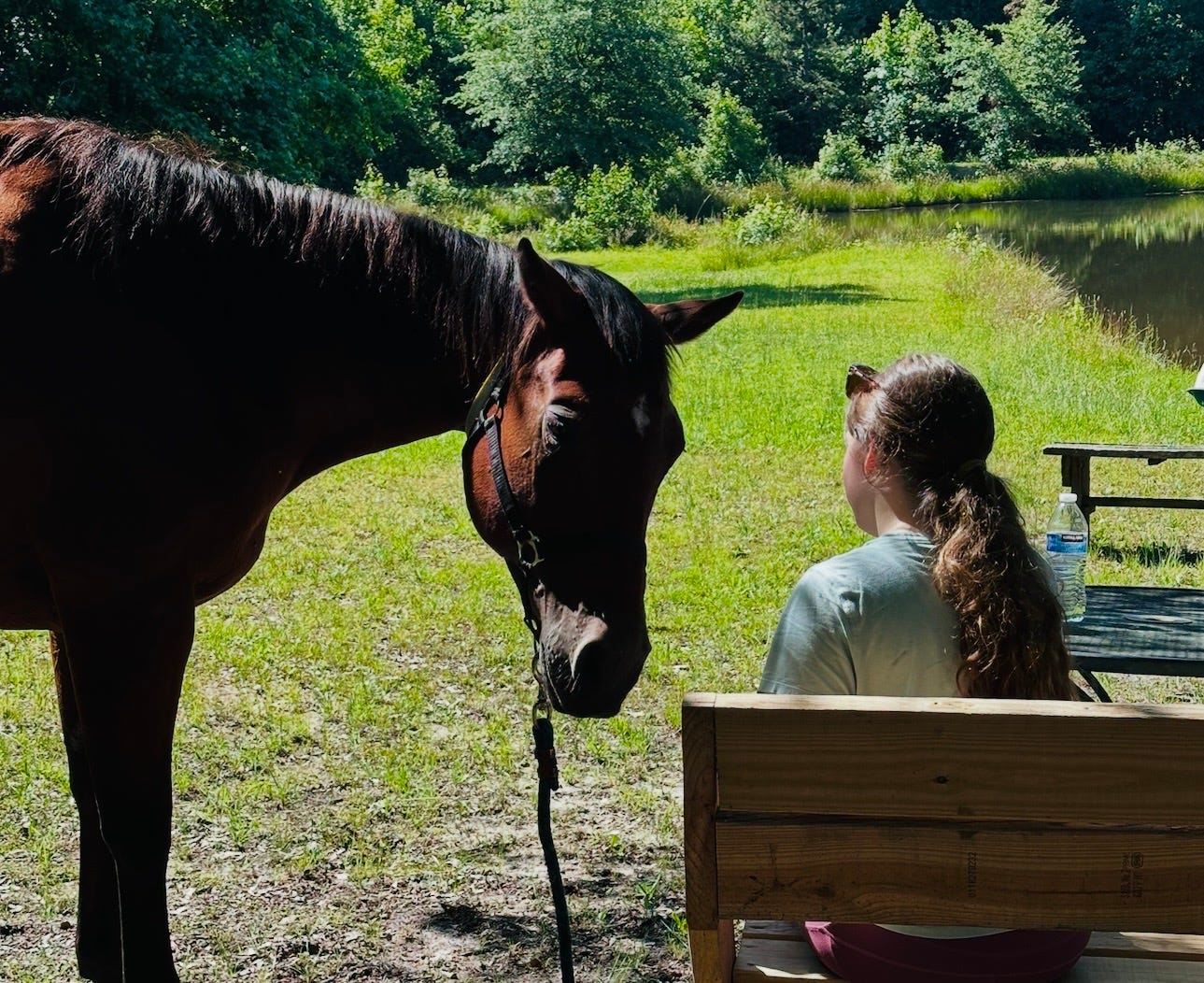
I didn’t start out translating horse to human (ie, teaching riding) thinking that I would enjoy teaching kids. I was barely an adult myself, twenty-five years old, electric with anxiety, and living my wounds out loud through pure determination and rage. I hadn’t stopped moving long enough to consider having kids of my own, let alone marketing my work to focus on them.
It’s a good thing that the number one consumer of horse goods is a horse crazy girl under the age of thirteen. I didn’t have a choice if I wanted to keep a full teaching calendar. For every adult who contacted me to begin riding lessons, twenty kids were already on my waiting list.
One memorable evening, I literally got down on my knees and begged the two teens who had been with me all day to call their parents. They didn’t have to go home — they just couldn’t stay with me one more second. I quickly gained a ton of sympathy for the hardened instructor I had grown up with. My friends and I were always at the barn. There was no getting rid of us.
But, as a kid, I did spend an afternoon at the library, in those days before the internet, looking up child labor laws in South Carolina. I wanted to activate a union for the barn rats like me who fed the horses at 6 AM in the summers and stumbled into their parent’s cars as the sun went down. I felt we were exploited, but also immensely glad to be held in the tall rafters of the barn’s arms. Anything was better than being home alone in those long summer days of television and frozen dollar pizzas. In my library research that day, I learned that state laws treated agriculture as its own animal, and that labor was a loose term with multiple avenues for interpretation.
When I went on to graduate college and spread my wings into the world, I suddenly found myself sharing skin with my old instructor, grumbling at kids to keep their heels down, and exploiting child labor to get the stalls cleaned.
Over time, I discovered another confounding truth — it is far easier to teach a child than it is to instruct an adult. A lot of that has to do with pattern recognition and how our brains change as we age.
Shockingly, and without warning, I realized that I had grown to like teaching kids. I liked hanging out with kids and laughing as we cleaned stalls together. When they leave the barn now, I’m kind of sad to see them go.
All that to say, let’s talk about why kids are teachable, and how we can train our brains to adopt a child’s mindset when we’re approaching any new or old task.
The Trouble With Adults
It is far easier to teach a child than it is to instruct an adult.
(Ugh. Did I really write that? I don’t know who I am.)
The tone of this statement might irritate adults, so before you start composing an email explaining why you’re the exception, hear me out.
Children are not inherently smarter than grown-ass adults. They are not more disciplined, and they are certainly not more coordinated. Most kids arrive at the barn unable to find their left foot with a map and a compass.
What children have going for them is that they are unfinished.
When a child shows up for a lesson, they understand that there might be a lot of things they don’t know how to do. Adults, on the other hand, believe that if they try hard enough, there will be something, somewhere, they already know how to do. They waste a lot of time trying to find it.
This difference sounds small until you spend a few decades teaching people how to work beside a horse.
At some point in our lives, many of us stop treating learning as a skill. We start living as if our identity is competence. Instead of approaching a new task with curiosity, we approach it with a terror of being seen making a mistake. I can explain something to a ten-year-old once and watch them attempt it immediately. Meanwhile, a forty-year-old will sometimes explain to me for five straight minutes why they cannot possibly do the thing I have not yet finished describing.
The horse notices neither age nor credentials. The horse only notices attention. And attention may be one of the most important learning skills we are losing. The longer I teach, the less I believe teachability has anything to do with intelligence.
I’ve worked with children who can tell you the breed, color genetics, and proposed discipline of every horse in the barn after a single visit. I’ve worked with adults who run businesses, manage teams, raise families, and make decisions carrying far more consequences than anything we do around horses.
Yet both groups can find themselves stuck in exactly the same place. They are smart and capable, yet learning a new task requires learning the strange and uncomfortable skill of stopping what you’re doing long enough to receive new information.
The horse world presents this challenge constantly, both in the saddle and on the ground. The most simple, mundane task, like removing a girth from a saddle, becomes a puzzle that can only be solved with practice and attention — two things that are very much in short supply in our over-scheduled world.
Up is Down
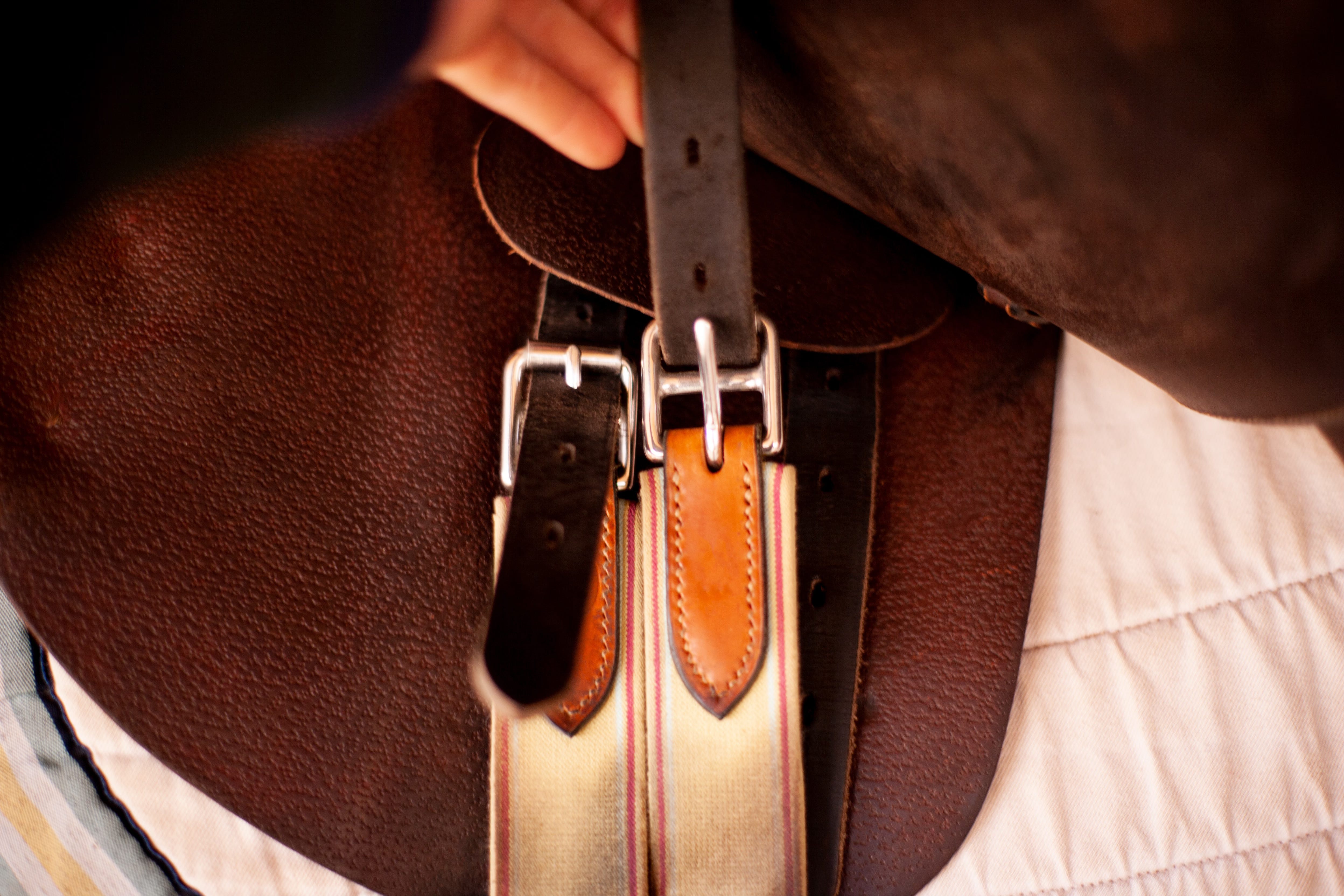
I was working with a delightful child I only get to see every now and then. She retains an immense amount of knowledge between breaks, just picking back up where she left off between visits to the farm. We stood in the tack room, and I watched her attempt to remove a girth from the billet straps of a saddle. The saddle was off the horse, and this usually makes the task easier because saddle racks don’t sigh and fidget.
Girth buckles are counterintuitive. You must press them up instead of down to release them. But no matter what I said or tried to help the child understand the task, my verbal guidance couldn’t break through her intense focus.
Her cognitive skills disappeared under the laser focus of her drive to solve the problem. This isn’t a rare occurrence in the barn, but it’s becoming increasingly common the longer I teach kids and adults how to work alongside horses.
Children are not becoming less intelligent and capable. If anything, many of the kids I meet possess astonishing stores of knowledge. They can recite facts about horses, memorize entire YouTube channels’ worth of information, and remember details from lessons months earlier.
This increasing challenge is that many children — and adults — appear to struggle with holding verbal information long enough to apply it to a hands-on task.

The Myth of the Visual Learner
We have all heard about learning styles, and most of us identify with some form of the descriptions. Someone struggles to follow verbal instructions, and we conclude they must be a visual learner. Someone wants to touch and experiment before listening, and we decide they are a kinesthetic learner.
The idea of typecasting for learning is appealing, but science has never really supported it.
Researchers have spent decades studying whether people learn best when instruction is matched to a preferred style — visual, auditory, or kinesthetic. Again and again, the evidence has failed to show a meaningful advantage. We absolutely have preferences, and most of us enjoy receiving information in some forms more than others. But preference and learning are not the same thing.
The brain does not learn through isolated channels. The brain learns by building networks.
The strongest learning occurs when multiple systems work together, as when we hear an instruction, visualize it, perform it, receive feedback, adjust, and then try again. Learning how to learn is all about discovering which door works best and then building as many doors as possible.
Every day, the multiple avenues of learning unfold inside a barn. A rider hears me explain how to shorten the bridle reins. They watch me demonstrate how to do it. They feel the reins in their own hands. They observe how the horse responds. Learning is happening through all the different pathways simultaneously.
When we excuse ourselves from developing an alternate pathway because we have labeled ourselves as a visual or hands-on learner, we may be unintentionally narrowing our capacity to learn.
And one of the most important pathways that is neglected is the ability to listen, hold information briefly in the mind, and then act on what we’ve discovered. Psychologists call this working memory.
Working memory is the mental sticky note that allows us to hear, “Push the buckle up, slide the tongue through the hole, then pull it free,” and retain those steps long enough to perform them. Without working memory, instruction evaporates almost as quickly as it arrives.
The child struggling with the girth buckle wasn’t refusing to listen to me. She wasn’t being purposefully difficult, but she was concentrating so intensely on solving the problem that she couldn’t simultaneously absorb new information about the problem.
Ironically, the harder she tried, the less able she was to hear my voice.
We all do this.
A Thousand Tiny Interruptions
What happens when our attention becomes fragmented?
Every notification on our phone or random disruption places demands on our cognitive systems, which are responsible for holding information in our minds and applying thought to a task. Technology isn’t destroying our brains — humans are far more adaptable than this — but many of us are spending less and less time practicing sustained attention, the doorway to learning.
Not too long after I hung out with the kid and the demanding girth buckle in the tack room, I found myself having a conversation with an adult.
This guy was bright and capable. He sincerely wanted to learn, but he was also talking through and around everything I said. He was talking while I explained the goals of the day, and when I demonstrated how to hold a halter to a horse’s face. He talked through me as I answered his questions. He talked around me while he made the type of mistakes I was trying to correct.
Finally, I just looked at him and said, “If you want to get the most out of lessons with me, you’re going to have to be quiet and listen.”
Thankfully, he took this very well, and he actually stopped talking. Then learning commenced.
Earlier, the child was so focused on solving the problem that there was no room for instruction. Her attention was so focused that the more she concentrated, the less she could absorb new information.
The adult struggled with the same problem from a different side. Instead of his attention being trapped by a task, he was trapped by himself.
Which brings us back to working memory, our mental scratch pad. Every new idea, task, or piece of information must be mentally jotted down in this cache before we can absorb it and find something useful to do with it.
We like to imagine our brains as vast warehouses of knowledge, but in practice, they function more like a small workbench. There is only so much space available at any given moment, and when more items cover the bench, the less room there is to work.
The child filled her bench with the awkward mechanics of the buckle, and the adult filled his bench with explanations.
This dude’s internal script went something like this (I can easily make assumptions because my adult mind does the same thing. It gets loud in there):
Why am I doing it this way?
Another instructor told me to do it like this.
Something happened last week.
I think the horse is feeling weird.
Am I doing this correctly?
Do I look like an idiot?
Should I already know how to do this?
All his thoughts took up valuable mental space, so there was nowhere left to put any advice I was giving.
Back to learning styles. When someone cannot follow verbal instructions, they tell themselves, I’m a visual learner. Or they want to do it by hand. All of us have preferences, but researchers have not been able to pinpoint clear evidence that people learn better when instruction is matched to a certain style. What they have found, however, is that learning improves when information is presented through multiple pathways simultaneously.
We hear it. We see it. We do it. We receive feedback. We adjust. We try again.
Horse people have always understood all this, before, during, and after the use of scientific language to describe learning.
When I first started teaching, I had zero desire to sign kids up for lessons. Pretty soon, the majority of my world revolved around teaching kids how to ride horses. Kids have truly taught me everything that I know. Over the course of three decades, my life as a riding instructor has given me a front-row seat to the adaptations and changes in how humans learn.
I have watched us all get less practiced in holding sustained attention. Listening is a skill, as is following verbal instructions and holding information in our minds while applying it to a task. Like every other skill, our ability develops through use.
The horse, as usual, doesn’t care how intelligent we are. They just want us to pay attention.
We can absolutely teach an old dog new tricks, just ask my border collie. Working memory can always be improved. The human brain remains remarkably adaptable throughout our lives. My family founded the Alzheimer’s Association in my region, and once again, I was given a front row seat to what happens when working memory malfunctions, but for all we know of dementia now, there is still so much we don’t know. Moments of terminal lucidity in Alzheimer’s patients show that memory isn’t lost in a person’s mind — it’s just hidden.
Kids are masters at taking the risk of incompetence to try something new. We can learn a thing or two from them.
And horses are masters of bringing us back to our gifts in a world that is increasingly designed to fragment our attention.
Adaptation requires practice.
A horse does not care how many books you’ve read, how many podcasts you’ve listened to, or how many social media posts you’ve saved for later. The horse is only interested in whether you can be present enough to see what is happening in front of you.
Horses constantly invite us back into a conversation with reality, and perhaps that is why children often thrive around them. Children are eager to learn. They do not believe that they are supposed to protect an image of themselves as competent. They are willing to try, fail, laugh, adjust, and try again.
The horse rewards this immediately.
Adults can learn it too.
In fact, I suspect that may be one of the greatest gifts horses offer us.
The longer I teach, the less I believe that intelligence is the determining factor of learning. The best learners are people willing to breathe through their discomfort and listen.
And if we’re lucky, the horse is patient enough to wait for us to remember how.
Love,
Kim
P.S. Speaking of becoming beginners again —
Summer camp sign-ups have been very slow at Bramblewood this year, and I’m hearing the same from farms all over the country. But while kids are focused elsewhere, I have been asked, over and over, to hold a camp for grown-ups.
So, August 25th-28th, I am launching an Adult Connection Camp.
This is an in-person event at our historic farm in Simpsonville, SC,, held over four days, Tuesday through Friday, from 10AM to 1PM.
Take a look at your calendar, and take some time off work. You deserve it.
If you’ve been looking for a place to slow down, learn something new, make mistakes safely, ask questions, and rediscover what curiosity feels like, this camp is made for you. Riding is not the focus, but each day we will work alongside the horses and amazing guest teachers who are masters of energy work, human growth, the arts, and animal communication.
No experience is required for camp. In fact, being a beginner may be the entire point.
I’ll post the sign-up form here and on all socials once all the details are finalized and we’re ready to launch. But if this is something you’d be interested in, comment here or message me so I can add you to the list to be the first to know.
Yes!! I would love to attend your Adult Attention Camp! I’m almost certain that I will be is SC then. Please send me future information about your plans. I SO love, appreciate and learn from your talks. 🥰Linda ….Pietra44@gmail.com