
Granny Magic
A witness statement from the Blue Ridge Mountains

One long, hot summer day before I met horses, my dad farmed me out to my older cousins. They lived near our house, down a long road, recently paved, that often showed the scattered remains of broken liquor stills in the ditches where the deputies had come through and busted things up. From the mountains of northern Georgia to the foothills of South Carolina, my family had a long history of making ends meet by making moonshine.
My father had found Christ and, as a result, didn’t imbibe. He was strict and frowned when I wore anything other than a skirt. Each Thursday evening, I recited Bible verses to him as he washed my hair in the kitchen sink. The only thing greater than my father’s sanctity was his ability to hold a grudge. When he was given full custody of me, he had no idea how to contain me or how to feed me, but he was bolstered by the knowledge that he had won.
But I was uncontainable, and he knew this, so during the summers while he was at work, he farmed me out to any available family member to keep an eye on me. It must have settled his mind knowing that if I found mischief, which I did, at least it was on someone else’s watch. There’s only so much personal blame a man can take.
On this summer day, with my father frowning, I wore short shorts and a tank top. My cousins and I played in the sprinklers that sprouted rainbows in their long, rolling front yard. The grass was spiny and drought-hard beneath my feet.
At some point, I began arguing with my boy cousin. He was argumentative and antagonistic (still is), but he likes to remind me that the women in our family are hard-headed. I don’t deny this.
With my attention fully focused on his nonsense, I was unaware of where I was running, and I barged leg-first into a kerosene heater that had been placed on the front porch to burn off fuel for storage. The cage around the heater was boiling hot. It took a moment for the synapses to reach my brain as I stared down at the blistered burn forming on my leg.
I’d walk straight into a hot kerosene heater again if it would stop my cousin from arguing with me. He stood there, slack-jawed and silent, his eyes roaming from the burn on my leg to my face. I think I probably sank down to the ground and started weeping. Once the shock had worn off, my older cousins went into action.
One ushered me into the house and started dialing numbers on the phone. “We’re calling Aunt Daisy,” she said. “She’ll pray the fire out of the burn.”

And pray, Great Aunt Daisy did.
Whether she was remote or standing beside you, Aunt Daisy would recite a Bible verse that had been passed down through the family along a twisting, but precise, lineage, and your skin would stop aching if it had been burned, or a wound would stop bleeding if normal first aid wasn’t successful.
Aunt Daisy’s ability wasn’t considered weird or evil. She was a community resource that everyone knew to call if medical care was too far away or too expensive.
In an area roughly ten square miles, I was surrounded by cousins and cousins of cousins. Our great aunts, like Daisy, were numerous and remarkable. They could talk off warts, stop blood from flowing, and take the fire out of burns. That hot summer day, my leg stopped hurting immediately, and while I wore the scar for a few decades, my pain was minimal, and I was back to arguing with my cousins in no time.
I don’t care if my healing was all in my head. Horses and belligerent ten-year-olds give little mind to placebos. It either works or it doesn’t.
Granny magic is as diverse as the hills and hollers of the mountain region my people came from. They brought their charms over with them on boats and their knowledge mixed with the vast generational archives of the indigenous people they encountered in the New World. My people are English, Irish, and Scottish.
On my mother’s side, Mary Magdalene Winchester, my 3rd great-aunt, was a store owner and midwife who took a world of secrets to her grave when she passed away in 1942 at the age of 94.
I was researching an ancestry project during a month-long semester in college when I first met her. I stood at the visitor center at the entrance to the Smoky Mountains and stared into the eyes of a woman captured in a painting. She was familiar and haunting. Her worn hands were at odds with my smooth and timid fingers. It felt like she knew something that I did not, but also that I knew things that I wasn’t ready to accept about myself.
My soon-to-be ex-boyfriend snapped photographs of her and handed me an envelope of slides that I keep to this day. I also owe him an apology letter. In time, the Matriarch of the Smokies was placed into storage, understandably so, because the visitor center sits just miles from the entrance to the Cherokee Reservation. Her portrait on the wall was just one more reminder that history books begin with the settlers and disregard the eons of knowledge that was already here on this land, kept within the minds, hearts, and souls of the original inhabitants.
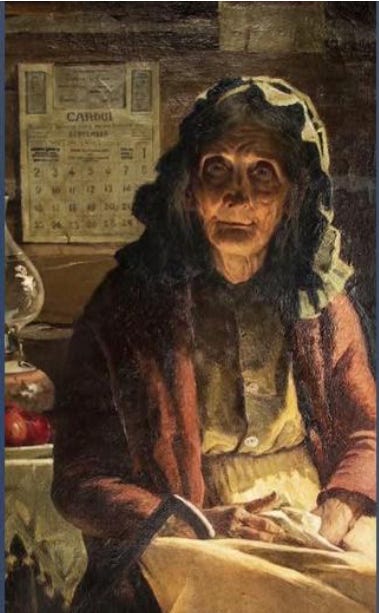
At home, I placed a photo of the painting in a tiny frame. My walls are filled with images, yet untold numbers of visitors to my house have stopped to stare at the vision of Aunt Winchester. Most are disturbed by her steady gaze and wizened face, the shadows that illuminate her from within. One person told me to turn it around so they wouldn’t have to look at her. Kids, though, are drawn to her and fascinated.
What is it about the mystique and mystery of elders from long ago that both delights and repels us?
Granny Core
Three things converged to usher in the rise of Granny Magic, like #grannycore and #cottagecore on our news feeds. All of them harken back to the same things that dimmed our ancestors’ way of doing things, as recorded in our cultural memory.
We’re not special. Periods of uncertainty have historically seen a surge in folk craft, as seen in the Victorian era and the back-to-the-land movement in the 1960s. Think of Marie Antoinette and her model farms, and of Leo Tolstoy and his obsession with the peasantry. And then there’s Henry David Thoreau’s Walden Pond. I traced the steps of W.B. Yeats and whispered, “Nine bean-rows will I have there, a hive for the honey-bee, and live alone in the bee-loud glade,” as I stared in wonder at The Lake Isle of Innisfree on the west coast of Ireland.
In modern times, the concept of homesteading witnessed a revival from the late 1990s through the 2010s. Gen Xers and young Boomers started gathering backyard chickens and planting gardens. Coupled with the essential oil industrial complex (pyramid schemes), people began making their own soaps. Heirloom seed catalogs began to outcompete J Crew.
In 2008, newly hatched Millennials watched their parents lose jobs, homes, and retirement plans in the crash that triggered the Great Recession. The promise of education, corporate work, and consumer culture began to look shady. DIY skills and gardening, along with an explosion in fear-driven prepping, became more commonplace.
We felt a sense of longing and dissatisfaction that culminated in everyone’s worst fears coming true during the Pandemic. 2018-2021 saw the rise of cottagecore on TikTok and Instagram. Rural imagery became a cultural phenomenon.
Right now, we’re living through the shift from cottagecore to grannycore. A lot of those people who sold out to homestead have been at it long enough to realize that it’s not a look, it’s a lifestyle. The aesthetic has cracked, revealing our lack of hands-on survival skills. The type of work that makes Aunt Winchester’s fingers gnarled in the portrait is proof of what returning to your roots does to your body. It’s not all pretty, it’s rarely clean, and there’s nary a day off work unless you’re shamed into stopping on the Sabbath.
Our minds are still reeling from all the changes of the 20th century. In one hundred years of human progress, a small amount of time compared to our cultural evolution, we erased most of our folk traditions. We launched ourselves into mobility and specialization as we left the farms for the cities. We started purchasing our goods instead of making them. We hire experts rather than learning from elders in our communities.
Then we started spending more time with various screens than with the seasons. The weather stopped being something we planned our crops by. The weather, for most people, is just an inconvenience or a potential disaster we are ill-equipped to bounce back from.
I live on a farm and have spent my entire life in touch with the seasons, and I’m so guilty of also ignoring the signs and the signals from Mother Earth. Throughout the 20th century, my family created a radio communications empire — thank you, Nikola Tesla. I lived television and radio intimately, from analog towers to cellular to digital. In many ways, I have that progress to thank for a life that made it possible for me to return to my roots on a farm.
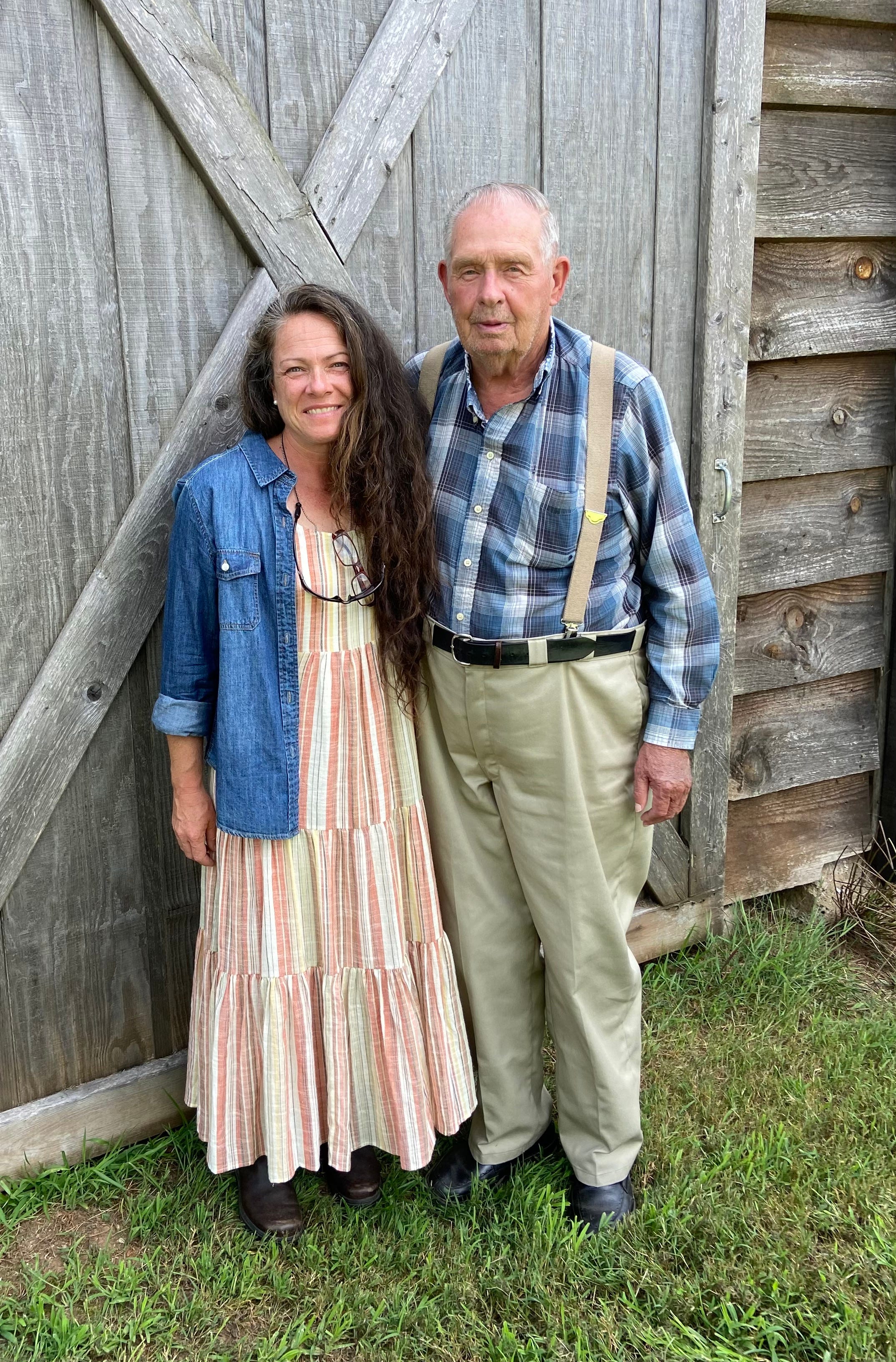
And Lord, I have been embarrassed by my country roots. Those old skills seemed simple and naive to me as I watched old women can vegetables and plow with a horse. I wear overalls every day, and it still galled me when I walked into a Cracker Barrel country store and found a dress that I would wear.
I bought the dress. It’s super cute. I pair it with a denim shirt and ankle-high boots. But I’m still a little ashamed to say where I bought it.
That cheek-burning revulsion I feel toward the last holdouts of country ways is actually a sign of the systemic programming that got us to this place where we yearn for the intuitive knowledge of the past but are beholden to the modern conveniences that chain us in place. We’re not as free as we think we are with all our stuff.
I wear my gnarly knuckles and my Cracker Barrel dress with pride now. But I had to really get over myself in order to embrace the gifts of living closer to the land.
What is Granny Magic?
Like my Aunt Daisy, talking fire out of burns and staunching a bleeding wound with prayer, granny magic takes many forms. But what’s super interesting is that these folk practices aren’t currently being embraced by anyone who has any memory of actual family members who practiced these incantations and rituals.
Most of us alive today had grandmothers who were trying, like me, to escape the stigma of country living and superstitions. The aesthetic we’re drawn to hasn’t been seen since the late 1800s and early 20th century.
Yet, we long for ritual and tradition.
Here are some examples of those rituals, still alive today, that you can adopt into your life. No harm done. And if you’re struggling with your longing for ritual that might feel at odds with your faith, no worries. I became Catholic so I could immerse myself in rituals galore, and remember that most Granny Magic was practiced by some of the most fundamentally faithful women on the planet. Ever heard of speaking in tongues and snake handling? Those things happen inside churches.
And yet — we have been programmed to fear the mystery. Programming that stems from the very same backlash against embarrassing, seemingly naive, rural practices. Those city preachers put on airs. They want to seem educated and important.
Pull up a chair and let’s explore the fading arts. Here are some uncommonly common practices you’ll still find deep in the mountains today:
Stopping Bleeding: A prayer is said, and the exact words are passed down to a very specific person in the family line. The knowledge is sometimes only handed down on Christmas Eve or Christmas Day.
Talking the Fire Out: Prayers are said over the burn to reduce pain and speed healing. It’s still one of the most common mountain healing traditions used today.
Removing Warts: Rub the wart with a potato, bean, coin, or string. The object is buried and prayers are recited.
Blessed Objects: Silver coins, herbs, and tokens are used to ease minor ailments.
Horseshoes Over Doorways: Some practices say to hang it upright, others say to hang it down, but either way, the placement over the doorway is said to bring luck and protection.
Cedar Branches: Hung in homes, barns, and outbuildings are said to offer purification and protection.
Bible Opened to Specific Passages: For protection during storms, or during illness and family crisis.
Crosses Over Doorways: Chalked, carved, or hidden, this symbol is intended for blessings and protection. Last year, our first Christmas in the new farmhouse, I chalked the front and back doors during Epiphany with 20 + C + M + B + 26. This old Catholic ritual includes the first and last numbers of the calendar year along with the sign of the cross and letters representing the Magi and the Latin for may Christ bless this house.
Weather and Nature Signs: Rings around the moon, woolly bear caterpillars, acorn production, persimmon seeds, the smell of the air before precipitation, fog patterns, bird behaviors — these are just a sampling of the myriad signs that are seen as important in the natural world. What signs have you inherited from your family? For me, it was always my father saying: Red sky at night, sailor’s delight.
Moon Lore: As above, so below is still very much at work today. One of my horse mentors instructed me to never plan elective surgery for the animals when the moon is waxing — they’ll bleed more. The tidal pull of the waxing moon is thought to pull all waters to increased strength, including the fluid in our bodies. The opposite occurs with planting when the increased water movement is thought to pull water toward the plant roots as the moon increases strength.
Household Signs: I was taught to never open an umbrella in the house, and the same goes for walking under an extended ladder. My Turkish ex would not hand a knife to someone unless the knife was closed in a sheath, or he spat on the blade before passing it to someone’s hands. There are instructions not to whistle after dark or to never put a hat on a bed. Sweeping over someone’s feet is considered an ill omen, as is putting an empty rocking chair into motion. Shoes were never to be placed on a table, but I think that one is self-explanatory.
Death Signs: The end of a life was preceded by warnings. This could be something as simple as a bird striking a house window, or an owl hooting nearby. Dogs continuously barking were an ominous call to pay attention. One of my family members only sees a certain bird before someone is about to die. There is also talk of stopping clocks at the hour of someone dying, and family members who have unusual dreams before and after a death.
Dreams and Messages: Before Carl Jung was analyzing our dream states, people had always given importance to the imagery in their dreams. There’s dreaming of water, or of teeth falling out, dreaming of weddings, or dreaming of snakes. Each holds its own messages, and many families still pay attention to that old, old imagery today.
Livestock Traditions: Who, reading this, still knocks on wood after discussing good fortune? I do. Prayers have always been recited over sick animals. I watched this magic in motion on Christmas Day last year when I’d exhausted all science trying to give ease to a sick horse. That’s not the only time that desperation has knocked my internal walls down far enough for me to embrace the mystery, and I’m always amazed at the results. The list of folk practices still used in animal husbandry is so vast that it deserves its own post. But things like a herd of cows lying down signaling rain, an unusually thick winter coat signaling a harsh winter, no new projects on Fridays, no buying or selling on Sundays, and telling honey bees about big family news, are all still used today.
Finding Lost Things: St. Anthony of Padua is the saint to petition for finding a lost object, but many families have their own spirits they petition and prayers they recite to find missing things. I once accidentally asked St. Jude, the patron of lost causes, for help because I forgot who I was supposed to ask. St. Jude delivered within moments. I cannot count the number of lost things I have found by praying.
Water Magic: Dousing is still used to find underground water for wells. I have a cousin who is brilliant at it. Certain springs have always been thought to contain healing powers. Ancient churches were typically built above natural springs. Some waters were considered to have healing properties, and water gathered at certain times contains blessings.
The Laying of Hands: This one comes straight from the Bible, where Jesus touched people to heal them. It’s still used with prayer in many churches today. Throughout history, there have been people who were known for their gifts of healing. Old communities and villages had members known for their healing touch. Mothers and grandmothers use their hands in similar ways when caring for sick children. There is power in human contact, and most of us are hungry for physical connection in a world that feels increasingly disjointed and out of touch.
What all these practices have in common is incredibly basic — they’re about paying attention. They’re also a great focal point for all the energy we have coursing through us every day that has nowhere to go. Exploring various granny practices also makes me pay attention to the intention I’m spreading. If I’m in an awful mood, it’s probably not a good idea to go spreading it around. I notice my moods, and the weather, and the color of the light as it spreads down through the treetops before the moon comes out.

My Witness Statement
Whenever I write about this kind of stuff, I feel like I’m going to be punished. I carefully type neutral language or broad third-person generalizations. I go back through and edit myself out.
My father always warned me that I was going to hell, but he also believed in Aunt Daisy’s ability to heal wounds. Those two sides of my psyche were firmly entrenched by the time I reached college,, and magic and mystery were confined to the bounds of literature, leaving science free to explain everything.
There are still many mysteries that science cannot explain — yet.
And here we are, all of us, living within the ditches of art/faith vs. science. All of our choices are dictated by this dichotomy, as if one cannot exist alongside the other.
I think we need both.
I have witnessed an incantation heal a sick horse. I have seen prayer work firsthand. I have watched a person be unable to cross a boundary set for protection. I have found lost objects by lifting my eyes to the ceiling and asking a helpful saint for a clue. I run my hands along the top line of a horse, the bladder meridian, and I watch them visibly relax, lick and chew, and release tension.
That last one is funny because I show everyone how to do this easy practice on a horse when they first visit the farm. One client is headed to vet school this autumn, and he was quick to dismiss the effects of a bladder meridian release until he tried it and it worked. The horse fell asleep under his hands. “I have to tell you, I thought this was bullshit,” he said.
Your proof is inside your practice. If you don’t try to work within the mysteries, confirmation bias will only show you the design of what you can only see with your eyes.
Personally, I don’t want to live in a world where all the answers make sense. There’s too much we don’t know, still, and I’m going to keep chasing ghosts until they speak words and give me proof that there is a world beyond our sight.
In the meantime, I take a quiet moment in hard times to walk my imaginary feet up the creaking steps of Aunt Winchester’s front porch. I’ll let myself through her strap-hinged front door and take note of the items stashed in shelves as I make my way to her kitchen.
I will sit down at her table and have her serve me stew from a pot boiling above the fire. As I lift the spoon to my mouth, I will bring my troubles to her and ask for her advice. She’ll smile at my questions and answer truthfully, whether I want to hear it or not.
And sometimes, if I’m very lucky, Aunt Winchester will give me a sliver of her knowledge.
Armed with that new/old medicine, I’ll return reluctantly to our world and get to work.
Love,
Kim

Oh Kim! I just love listening to your writing and share so many of your sentiments and perspectives. I hope someday we can collaborate in some way ❤️
A number of years ago, which is what I say when I know something wasn't yesterday or fifty years ago but somewhere in between, I visited the grave of a beloved auntie. I just sat there in the grass for the longest time. I remember the sensation I felt in my body when I understood that the wise woman mantle was being passed on... to me.
I love the way you think. More than that even, I love you ❤️