
A Future Me Problem
A field guide to modern worry

You know the drill. You imagine a problem you’re facing and ask: Will this matter a year from now? Or maybe it hasn’t even ripened into a real concern yet — what a kid in my barn once called a “future me problem.” Time heals most wounds. I can’t remember what she was worried about. I’m sure she can’t either.
In the same vein as this thought experiment (or, in the case of the kid, thought bypassing), I came up with a little game. It arrived one morning between waking and sleeping, which is when all my good stuff usually floats to the surface. Most mornings, I’m too lazy to write them down, but this time, I stared at something directly with my eyes open — the mantel against the wall, old and skinny, just broad enough for a candlestick — and I imprinted the thought into my narrative brain so I could remember the details later after some coffee.
What if I took a problem and placed it in another time frame? Like 1974 or 1862. Taking what I know about tools available, or the viability of the problem itself — my MacBook running QuickBooks too slowly just wouldn’t be a problem in any time period except now — is my problem still a problem?
If the answer is no, then maybe the problem isn’t as permanent or universal as it feels.
If I lived in another year entirely, would this still be a problem?
It’s a thought experiment, but it also exposes the hidden assumptions within the problem itself. Most of us approach our problems as if they’re objective facts, but they’re usually products of the particular time, culture, technology, economy, and set of expectations we live in.
If I drop my problem into 1899, 1957, or 1972, many of the things that often keep me awake at night would simply evaporate. The world wasn’t easier by any stretch of the imagination in other times, but the framework that creates many of my modern problems just didn’t exist.
For example:
In 1899, nobody wondered if they should build a personal brand.
In 1972, nobody checked whether they had been texted back.
In 1943, nobody was paralyzed by the choice of forty-seven streaming options.
In 1825, the farmhouse that I live in was brand new. The people who lived here had their own versions of comparison, envy, ambition, and insecurity. They were human, and comparison has been around as long as our species, but their attention was mostly anchored to the people and problems directly in front of them. They didn’t carry an entire world’s worth of comparisons around in their pocket.
What Year is My Problem From?
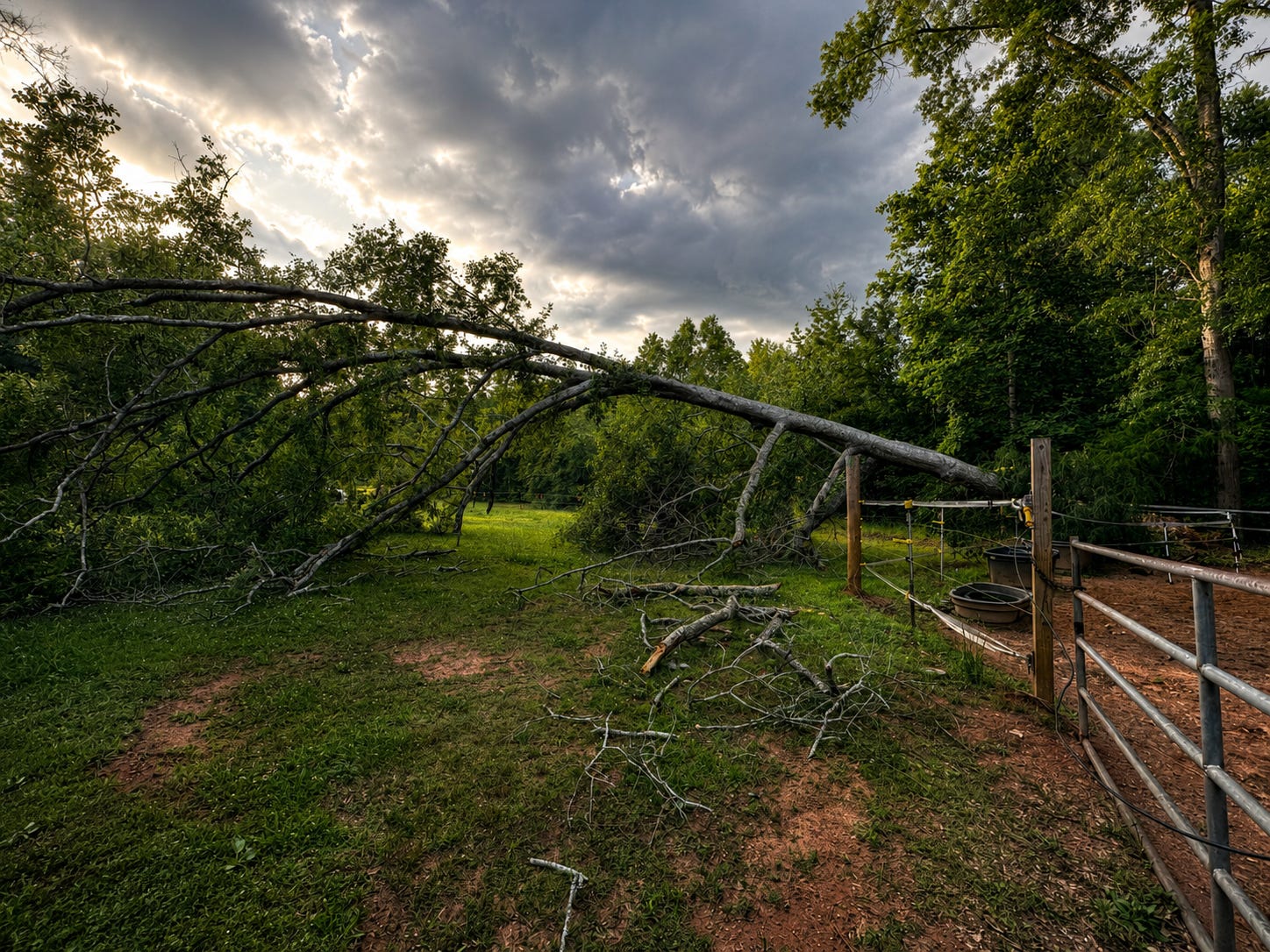
Take the tree near the graveyard field that fell down after a heavy rain the other week. Almost two years have passed, but we’re still littered with the remains of Hurricane Helene and the forest roots are healing. Drought followed by days of drenching rain was another perfect storm.
Christopher had just completed his walk of the fence line after work at midnight, and he heard it crashing down. Thanks to our land spirits, the enormous water oak didn’t crush much fencing. It sat on top of the fence where it had fallen and barely grazed the rest with the tip of its leaves. But it was huge and directly in the juncture of two often-used gates. Something had to be done about it.
In the dark, I stared at the broad trunk suspended on its branches like a person doing a plank, and my mind raced toward solutions. The tree’s precarious perch left me unsure whether we could manage the clean-up ourselves. As my mind raced, I wondered what would have happened if this same tree had come down in 1825.
What year was this problem from?
Trees have been falling since they first sprouted on Earth. One hundred, two hundred, a thousand years ago, a fallen tree was a potential problem. As I stared at the tree, I realized that the existence of the tree itself wasn’t what was taking most of my attention. Before a single cut had been made, I had already taken photographs, sent texts, considered insurance, thought about equipment, calculated costs, wondered whether more trees were likely to come down, and mentally sorted the situation into the growing pile of things that needed my attention.
In 2026, the tree was on the ground, but it was surrounded by an entire cloud of decisions. What would have happened if the same type of tree had fallen in 1825?
The person responsible for this farm would have walked outside and viewed the same scene as I did. They would have seen a fallen tree and some minor fence damage. There was work to do, and their tools would be different from mine. They wouldn’t have a chainsaw, a tractor, or the internet. The physical work needed to clear the tree would be harder than what we are facing, whether we hire a professional or Christopher hones his skill with the battery-powered chainsaw.
I’m assuming that in 1825, there would have been fewer decisions. The tree would need to be cut up. The fence would need to be repaired. The wood would need to be hauled somewhere, or repurposed into building material. In 1825, the problem would have been tangible, immediate, and largely self-explanatory. The solution would live in the same immediate, physical area as the problem.
We often assume that more options make life easier. Sometimes they do. I would much rather clear this tree with modern equipment than with a crosscut saw and a team of mules. However, every new tool also comes with a collection of choices. Modern problems entail research, comparison, planning, forecasting, documentation, communication, and a thousand possible paths forward. We spend an enormous amount of energy managing problems before we ever begin solving them.
The people in 1825 didn’t have it easier. They carried burdens I don’t have to carry and faced uncertainties I can barely imagine, but when I run this little experiment in my mind, I discover that what feels overwhelming is all the mental noise attached to finding a solution for a problem. The problem itself is relatively simple compared to orchestrating a solution.
And we wonder why we have decision paralysis.
When I ask myself what year a problem belongs to, it forces me to focus on the tree.
Most of my modern exhaustion stems from considering every possible version of a problem rather than just dealing with what’s propped up in front of me.
The Curious Case of the Dead Mouse in the Feed Bag
After we moved the farm and things began to settle down last year, my mind had a lot of empty space for worry. We’d started feeding round bales of hay in the pasture, and on cue, my newsfeed became packed with horses along the East Coast dying from botulism in their hay supply.
I texted the vet and asked if we should vaccinate the horses for botulism. She assured me that our chances were low and our hay relatively safe.
I forgot about botulism until Sunday morning when Savannah approached me with a scoop of grain sprinkled with a mummified mouse. The rodent had crawled into the commercial feed bag and expired. I instructed Savannah to dump the feed pans, trash the grain, and scrub everything with detergent.
I texted the vet and asked how long I should worry about botulism.
She responded immediately (bless her, the way she copes with the messages I send on Sunday mornings) and bestowed good sense. The horse had eaten. I couldn’t change anything, so she told me not to lose sleep and just watch the horses for an inability to swallow.
I asked her how long I should not worry.
She said 10 days.
Our vet always leads me back to the practical — that’s why she’s a genius at her job. I wouldn’t fault her for sending an invoice for the time she spends managing me. We’ve given her medical mysteries to figure out aplenty, and she’s brilliant at it. She talks me off ledges before I plunge into wasting all my energy worrying about things I can’t change.
She didn’t dismiss my fears and the risk of botulism. It’s a real and serious threat whenever a decomposing creature creates an environment for feed contamination. But her response cut through all the activity happening in my mind and returned me to the reality of the situation. The feed had already been fed. The exposure, if present, had already occurred. There was no action left to take in that moment beyond watching and waiting.
What if this had happened in 1825?
The people living on this farm would have understood that spoiled feed could make animals sick. They would have known that contamination was dangerous, but they wouldn’t have known the word botulism because the bacterium responsible for the illness wasn’t identified until 1895. If they found a dead mouse in a sack of grain, they would have recognized a problem without necessarily understanding the biology behind it.
They would have removed the mouse.
They might have discarded some of the feed.
They might have worried.
But they could not have spent the next hour researching symptoms, reading articles, texting a veterinarian, or imagining every possible outcome because those tools didn’t exist.
Ironically, a hundred years later, in 1925, they would have known about botulism. Scientists had already identified the organism. The disease was understood well enough that the food industry was paying close attention to it. Yet even then, standing in a barn with a dead mouse in a feed sack, the practical reality would not have been all that different from what my veterinarian told me this morning.
The horses have already eaten it.
Now you wait.
I wonder if one of the defining characteristics of modern life is our ability to know about a problem long before we can do anything about it. We are surrounded by information, and we know the root causes of things that were mysteries to our ancestors. We can contact experts instantly. We can access an almost unlimited supply of knowledge.
What we often cannot do is change the outcome. Knowledge and control are not the same thing — and for that, when it comes to the things that truly do matter, the answers are the same today as they were four hundred years ago.
When Savannah brought me the dead mouse, I had access to veterinary expertise, scientific explanations, timelines, symptoms, probabilities, and treatment information. Yet all that knowledge eventually led me right back to the same place someone might have arrived in 1825, standing in a barn doorway, holding a dead mouse by the tail.
Well. We’ll know soon enough. The only thing left for me to do is wait.
And waiting has become one of the hardest skills for modern people because we have grown accustomed to believing that if we gather enough information, think hard enough, and worry thoroughly enough, we can control and maneuver outcomes for situations that haven’t happened yet.
Not every problem belongs to today.
Some of them belong to tomorrow. Some of them belong to the past.
And some problems aren’t problems at all, they’re just uncertainties that may or may not bear fruit in the future.
Will my problem matter a year from now? Would my problem have mattered a hundred years ago?
If I carried my problem back to 1974, would it still exist? (I was just getting started, but it was also the year that women in my state were allowed to open their own bank account without a male co-signer). If I dropped my problem into 1862, would I recognize it? If I were living and working at this farm in 1825, would my problem keep me awake at night, or would some larger, more immediate reality place it in proper perspective?
In this experiment, my problem sometimes disappears entirely, revealing itself as a modern invention. Other times, the opposite happens. The details fall away, and I discover that underneath the modern packaging is something much older — a problem that could not be solved without current technology, or not a problem at all because the problem couldn’t exist.
The question isn’t really about social media, dead mice in feed bags, QuickBooks, text messages, insurance claims, or fallen trees. This question brings us to the core of what we think about security, belonging, responsibility, uncertainty, love, and loss.
Our concerns change with our habits, but the deeper human concerns remain consistent through the ages.
What this exercise truly achieves is reminding me that not every problem deserves equal space in my mind. Some of them are current and require action. Some belong to the past and have already happened, whether I accept it or not. Some belong to tomorrow and will reveal themselves in their own time. And some aren’t really problems at all, they’re just uncertainties waiting to, maybe, become facts.
The next time you find yourself staring at a problem that seems impossibly large, try moving it. Place it in another decade. Another century. Ask what resources would have been available. Ask what expectations people carried. Ask whether someone in another time would have recognized your problem as something that needed time and resources.
You may discover that the problem shrinks or becomes clearer. Or you may find, as I often do, that the thing exhausting you isn’t the problem itself but all the importance you attach to it.
Stepping back in our perspective helps us shift our view, as when we step back from a painting to see what’s inside the full frame. When your nose is pressed to the canvas, all you can see are individual brushstrokes: a streak of blue, a patch of shadow, a line with no beginning or end. The closer you are, the more important every detail appears.
When you take a step backward, the brushstrokes don’t disappear, but you can finally see how all the pieces fit together.
I think problems work the same way.
When I’m standing too close to one, it becomes easy to believe that the thing consuming my attention is the entire story. The fallen tree becomes a hundred decisions. The dead mouse becomes ten days of worry. The unanswered question becomes a dozen imagined futures.
Asking what year a problem belongs to is my way of taking three steps backward. It allows me to see it more clearly.
Not every problem belongs to today. Some of them belong to tomorrow. Some of them belong to the past. And some problems aren’t problems at all, but questions that time hasn’t answered yet.
Until it does, there is often nothing left to do except take a few steps backward, return to the work in front of me, and allow the bigger picture to come into focus.
Love,
Kim

What I realized is that the news (written or televised, etc.) is often a story of what could happen...and I start worrying about it...new diseases, a war escalating, and etc.. Just like you say in looking at how people dealt with worry long ago, before radio and television, we had a smaller space for worry. Because we're overloaded with stories now, it can be difficult to maintain our peace. I read a while ago that the best way to get a good sleep includes taking deep breaths and agreeing to release all the experiences of the day, good and bad, allow the body to relax and envision something good happening on the next day. I think I will try that.
Your story makes sense and helps me understand some of the hows and whys in my life. I usually say a broader perspective will be helpful but sometimes we’re just up to close and can’t see it. Thanks for sharing